

Define Your Career North Star (Even If It Changes)
Why you need a target job role before you start applying, and how to find yours

Welcome to a new phase. In the last few posts, we did the essential mental work to get into the Mosaic Mindset. You are not a collection of random jobs. You are a unique mosaic of valuable skills and experiences.
Now it’s time to build the strategy around that truth.
And the very first step in any strategy is to know where you’re going.
Before you update your resume, before you write a single application, you need to define your goal.
The Spray and Pray Method
I know how tempting it is to just jump right in.
You open LinkedIn. You see a few interesting-looking jobs. And you start firing off applications. The “spray and pray” method. You’re applying to dozens, maybe hundreds of jobs, hoping something sticks.
The problem is, it’s exhausting. And it rarely works.
Why? Because every application is generic. You sound like every other candidate. You burn out, you lose confidence, and you just repeat the cycle.
We’re not going to do that.
Instead, we’re going to take a targeted approach. We’re going to define a “North Star” for your job search.
This isn’t a life sentence. It’s a hypothesis. It’s a direction that will make every other step of this process more exciting.
And we need excitement in this process, because let’s be real, it can be grueling sometimes.
Finding Your North Star
So how do we define this North Star?
I start with a simple question: “What is something that gets you so excited, you would love to be a part of it in any shape or form, 5 days a week?”
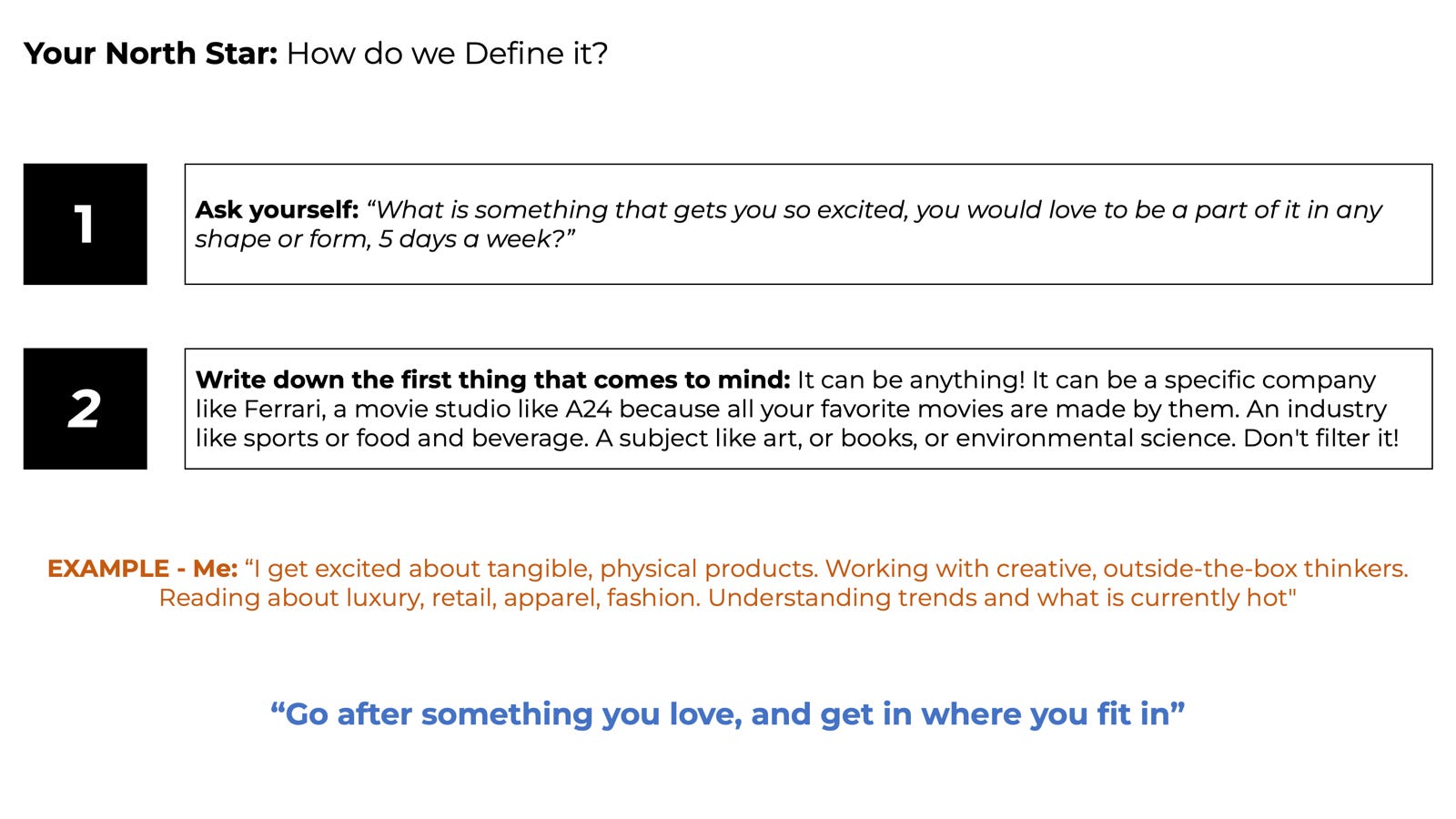
For this to work, you need to say or write down the first thing that comes to mind.
It can be anything. It can be a specific company like Ferrari. A movie studio like A24 because all your favorite movies are made by them. An industry like sports or food and beverage. A subject like art, or books, or sustainability.
Don’t filter it.
One of the biggest pieces of advice I ever got stuck with me years ago. It was, “Go after something you love, and get in where you fit in.”
What does that really mean?
It means going after something you’ll genuinely enjoy and be passionate about. Doing something that excites you to get out of bed in the morning and doesn’t make you dread the commute to work or logging onto your computer.
Why This Matters
Now, some people will say, “Who cares? A job is just a job for money. That’s why you have hobbies outside of work.”
I strongly disagree with this mindset.
Let’s just break down the math on this. Most people work 5 days a week. But it’s more than that. On a workday, a huge chunk of your 24 hours is focused on work. Getting ready, the commute there, the commute back, decompressing...then you start all over again.
A significant portion of your life is dedicated to your career.
So why would you choose a job you don’t enjoy? The argument that you should just do it for the money is not sustainable, mentally or emotionally. I always advise people to pursue a career they can enjoy for a long time.
And it’s not just about happiness. It’s practical.
Passionate people tend to climb the career ladder faster. Why? Because they’re eager to learn, they work hard to become experts in their field, and subject matter experts are invaluable to any organization.
While I can’t tell you what career to choose, I encourage you to delve deep into yourself. Listen to your mind and your body, and don’t worry about external influences or what other people are doing.
You know what’s best for you.
People who truly love their jobs feel successful, however they define that word.
The Career Trifecta
So I want you to consider your hobbies, your passions, and your work preferences.
Do you like an office or being hands-on? Working with people or independently? A physical job or one in front of a computer?
We take that core passion and align it with a framework I call the “Career Trifecta.”
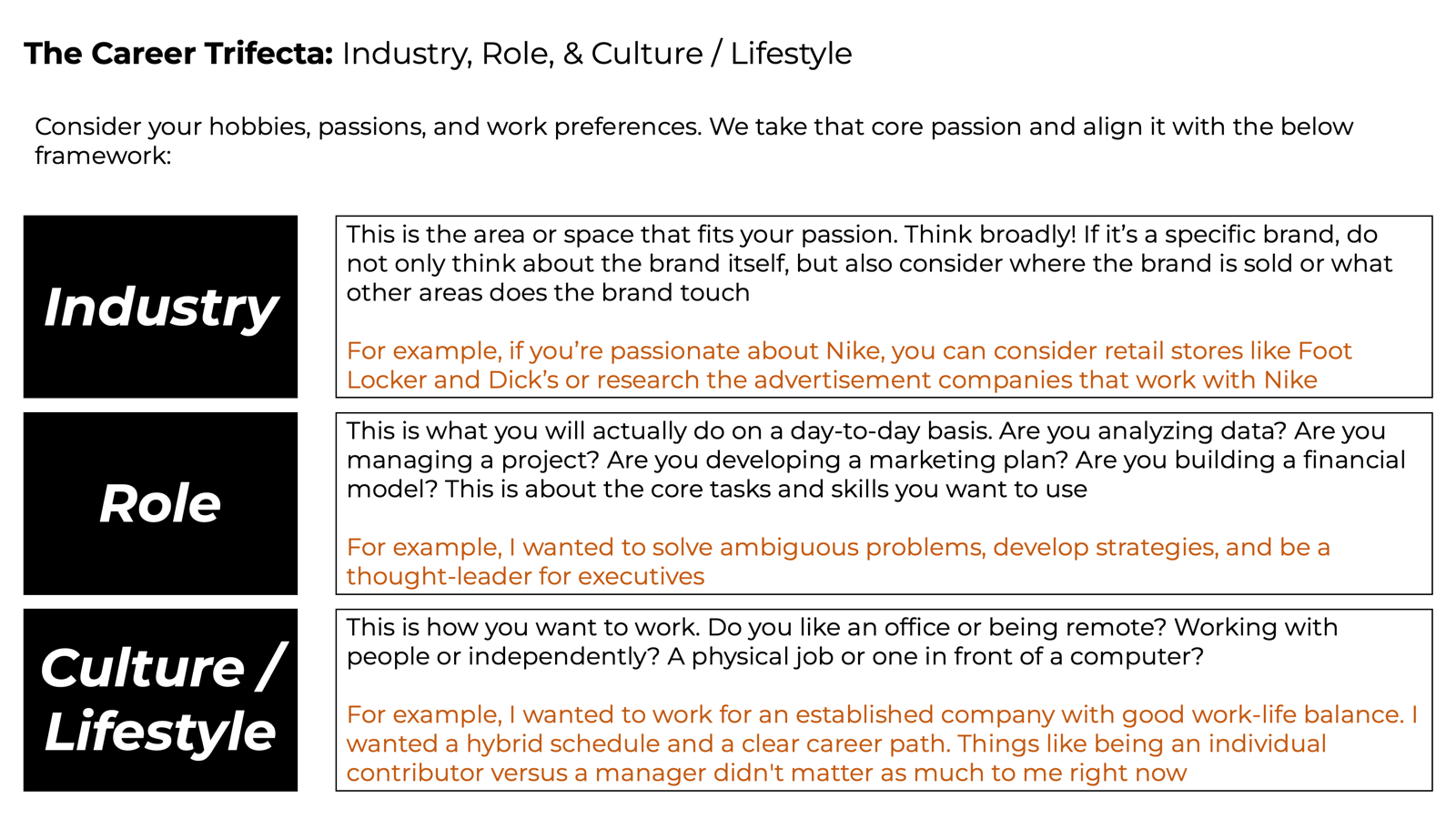
First: The INDUSTRY
This is the space that fits your passion. And think broadly.
For me, my passion was the apparel and fashion industry. But I also looked at adjacent industries. Beauty, luxury goods and services, entertainment, sports (they sell team merchandise), anything that touched that world in some shape or form.
This opens up a lot of options. For example, I interviewed for the consumer goods division of the NFL. Sports. I also interviewed for the Digital Strategy team at Moet Hennessey, an alcohol beverage company owned by a large luxury conglomerate.
Second: The ROLE
This is what you actually do day-to-day. Are you analyzing data? Are you managing a project? Are you developing a marketing plan? Are you building a financial model?
This is about the core tasks and skills you want to use.
I knew I wouldn’t be a designer within the apparel and fashion industry, even though I think that’s really cool. I had to look at what I’m good at: solving problems, analyzing ambiguity, and developing strategies. So I targeted roles with those characteristics.
Third: The CULTURE and LIFESTYLE
This is how you want to work.
After experiencing so many environments, I was strict about what I wanted: an established company with good work-life balance. Meaning when I’m home, I am off. I wanted a hybrid schedule and a clear career path.
Things like being an individual contributor versus a manager didn’t matter as much to me right now.
Your Task
Here’s your task for this post. I want you to do a low-pressure brainstorm.
And don’t do it right now, because you’re just finishing this post and your ideas may be a bit skewed by my examples. Do this tomorrow or later on.
Ask yourself, “What is something that gets me excited that I would love to be a part of in any shape or form and do it 5 days a week, every week, every year?”
Think about what you enjoy doing, reading about, and learning about.
If you can’t come up with an answer, ask some of your closest friends or relatives this question: “Based on what you know about me and my passions, what do you think I would enjoy doing as a career?” They may or may not have an answer, but that could help.
Once you’ve got it, write these ideas down. Start thinking about the types of roles related to that. Have a list of potential roles, industries, and your ideal culture.
It doesn’t have to be long, but it’s a good start. The goal is to create that North Star and get you genuinely excited about this whole process.
Because, as I said before, there are going to be a lot of ups and downs. And you always feel the downs more. It hurts. But if you are excited about this process, your mindset shifts, and those blows don’t hurt as much.
This clarity is the foundation of our entire strategy. Once you know where you’re going, it’s much easier to build the map to get there.
Take some time to work on your passions and Trifecta. In the next post, we’ll use this target to start decoding job descriptions and uncovering the skills you need to highlight.
I’ll see you there.
Next up: Stop Reading Job Descriptions Like a Rejection Letter

Here is the complete career playbook (all 26 posts with real-world interview, resume, and career examples) for anyone who is pivoting roles, industries, about to graduate, stuck in their current path, not sure what to do next, etc.