

Master Behavioral Questions With the STAR Method (Plus the Secret '+L')
How to turn your Skills Vault stories into undeniable proof of your value

Welcome to a new phase. In the last few posts, we built our core narrative tools: the resume, the “Tell Me About Yourself” pitch, and the P.O.W.E.R. framework.
Now it’s time to learn how to use those tools in the interview itself.
The 80% Rule
I would say that about 80% of any given interview is made up of what are called behavioral questions.
These are the questions that start with “Tell me about a time when...” or “Give me an example of...”
And if you are interviewing for a company like Amazon, this is like 100% of the interview.
Why do they ask these? Because your past behavior is a great predictor of your future performance.
It’s not enough for you to say you’re a great problem solver. They want you to prove it with a real story. This is where your Skills Vault becomes your most valuable asset.
The Biggest Mistake People Make
Now, the biggest mistake people make here is rambling.
They tell a long, confusing story with no clear point.
To avoid that, we’re going to use a simple, powerful storytelling framework that many of you have probably heard of: the STAR Method.
A lot of people know the acronym, but very few execute it well. I don’t want you to think of this as a rigid, robotic formula. I want you to think of it as a structure to make your stories concise, compelling, and impactful.
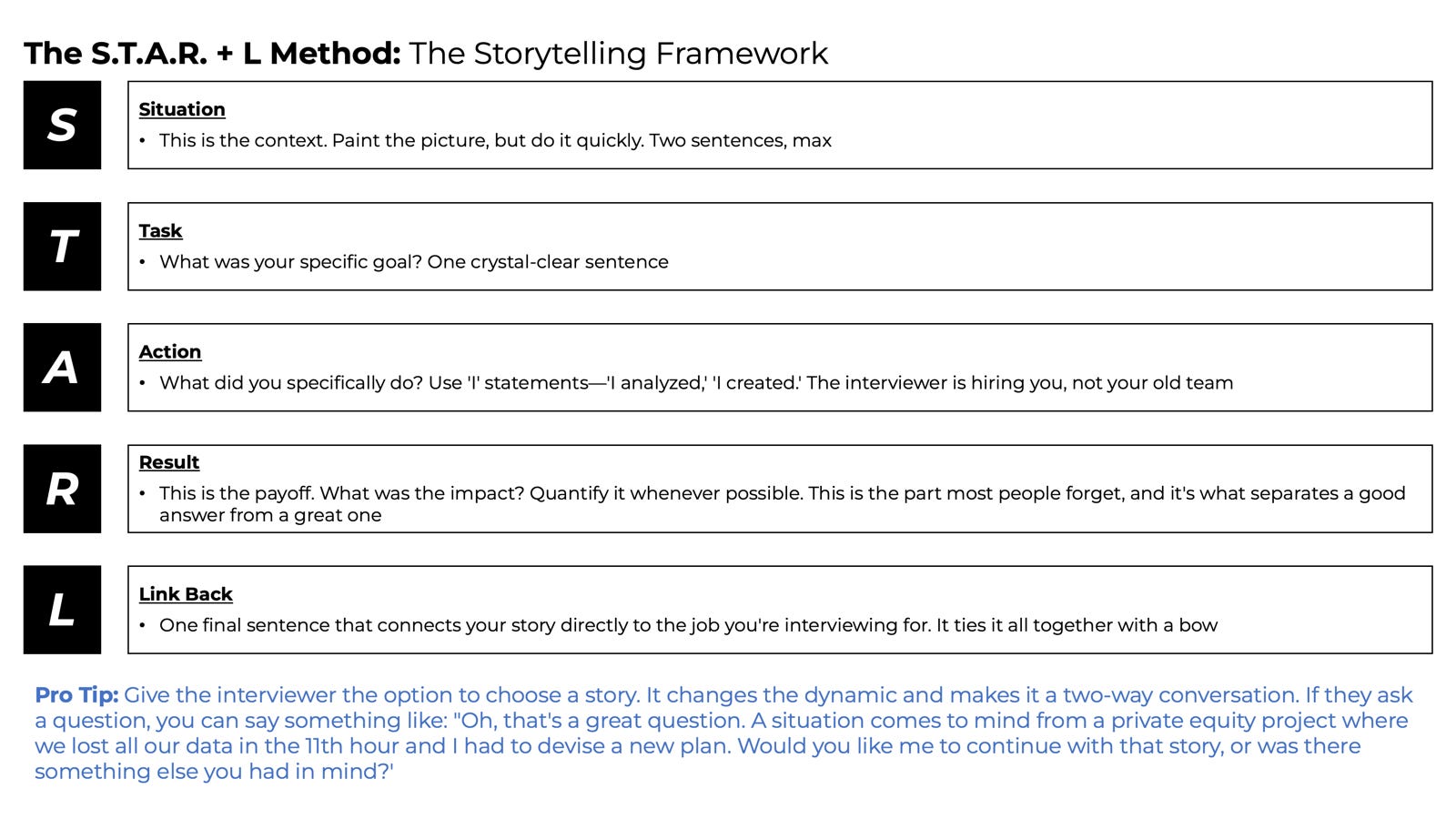
The STAR Framework
S stands for Situation. This is the context. Paint the picture, but do it quickly. Two sentences, max.
T stands for Task. What was your specific goal? One to two crystal-clear sentence(s).
A stands for Action. This is the most important part. What did you specifically do? Use “I” statements. “I analyzed,” “I created.” The interviewer is hiring you, not your old team.
R stands for Result. This is the payoff. What was the impact? Quantify it whenever possible. This is the part most people forget, and it’s what separates a good answer from a great one.
Case Study 1: Handling “Tell Me About Your Biggest Failure”
This is an advanced use of STAR. Here’s how I’d break it down.
(Situation/Task): While in Consulting, I was managing a $750,000 project for an executive coaching client. I was overly confident and set an extremely ambitious deadline without fully considering my team’s individual workloads.
(The Challenge / The Failure): As we got into it, the team became overwhelmed. We started missing internal deadlines, morale dipped, and I realized I had failed to plan realistically.
(Action): I immediately took ownership. First, I apologized to my team for misjudging their capacity and then I transparently communicated the situation to the Partners and the client. I then revised the project plan, adjusted the deadline, and brought on an additional team member to rebalance the workload.
(Result): While I missed the initial aggressive deadline, I delivered a high-quality analysis within the revised timeframe. The client actually appreciated my transparency and proactive communication, and praised the final results.
(The Lesson & Impact): That experience taught me a huge lesson about realistic planning and team management. I implemented new processes on my next project, which I delivered ahead of schedule while keeping team morale high. It made me a better leader.
See that? You’re honest about the failure, but the focus is on ownership, action, and learning.
Case Study 2: Handling a Difficult Client Interaction
Question: “Give me an example of your most difficult customer interaction and how you worked through it.”
(Situation/Task): At my Consulting role, I was managing a growth strategy project for a $200 million customer data company. In our final presentation, the client suddenly fixated on a new market that wasn’t in our original scope, and this eleventh-hour request threatened to derail the entire strategy.
(Action): I knew we had to act fast. Within 48 hours, I led my team in a focused data sprint. I coordinated interviews with experts, I had the team analyze new market reports, and I personally built a new financial model to evaluate their specific request against our recommendations.
(Result): The next week, I presented a new, data-driven recommendation that directly addressed their concerns. They were thrilled by our responsiveness and flexibility. Not only did they accept our strategy, but we also successfully secured a follow-up project valued at $2 million to implement the plan.
(The Link Back): And I’d finish by saying, “This experience showcases my ability to handle high-pressure client demands, lead a team under tight deadlines, and deliver data-driven solutions, which I believe align perfectly with the capabilities required for this role.”
The Secret “+L” (Link Back)
Now for the pro tip. That last sentence is what I call the “+L” or Link Back.
It’s one final sentence that connects your story directly to the job you’re interviewing for. It ties it all together with a bow.
The Advanced Move: Give Them a Choice
Another pro tip, and this is an advanced move.
I like to give the interviewer the option to choose a story. It changes the dynamic and makes it a two-way conversation.
If they ask a question, you can say something like:
“Oh, that’s a great question. A situation comes to mind from a private equity project where we lost all our data in the 11th hour and I had to devise a new plan. Would you like me to continue with that story, or was there something else you had in mind?”
This is powerful because it brings them into the conversation and confirms you’re about to tell a story that’s relevant to what they really want to know. It gives you control.
Your Task
So here’s your task. Go back to your Skills Vault. Pick three of your most powerful stories.
For each one, write it out explicitly using the S-T-A-R format. Get specific with the Actions, quantify the Result, and write that “+L” link-back sentence at the end.
And for one of them, practice that “offer a choice” opening.
This exercise is the core of your interview preparation. It turns your stories into undeniable proof of your value.
In the next post, we’ll cover a different kind of question. Situational and hypothetical questions that test your judgment about the future.
I’ll see you there.
Next up: Acing situational and hypothetical questions
Here is the complete career playbook (all 26 posts with real-world interview, resume, and career examples) for anyone who is pivoting roles, industries, about to graduate, stuck in their current path, not sure what to do next, etc.