

Master 'Tell Me About Yourself' (The Question That Makes or Breaks You)
Why you need three different versions of your story, and how to build them

Welcome back. In the last post, we built your resume. That’s your written marketing document, the “movie trailer” for your career.
Now we’re going to craft the most important spoken piece of your narrative.
We are going to master the first, and most important, question of any interview: “So, tell me about yourself.”
This Is Not an Icebreaker
Let me be clear: this is not an icebreaker.
This is the opening argument of your case. It is the single biggest opportunity you have to frame your entire story, take control of the narrative, and set the tone for the rest of the conversation.
How you answer this question can literally make or break your interview.
Most recruiters and interviewers make a Yes or No decision in the first few minutes of your interaction with them.
You Need Three Versions
Now, the key to a great answer is preparation, and understanding that one size does not fit all.
You actually need three different versions of your pitch ready to go at all times.
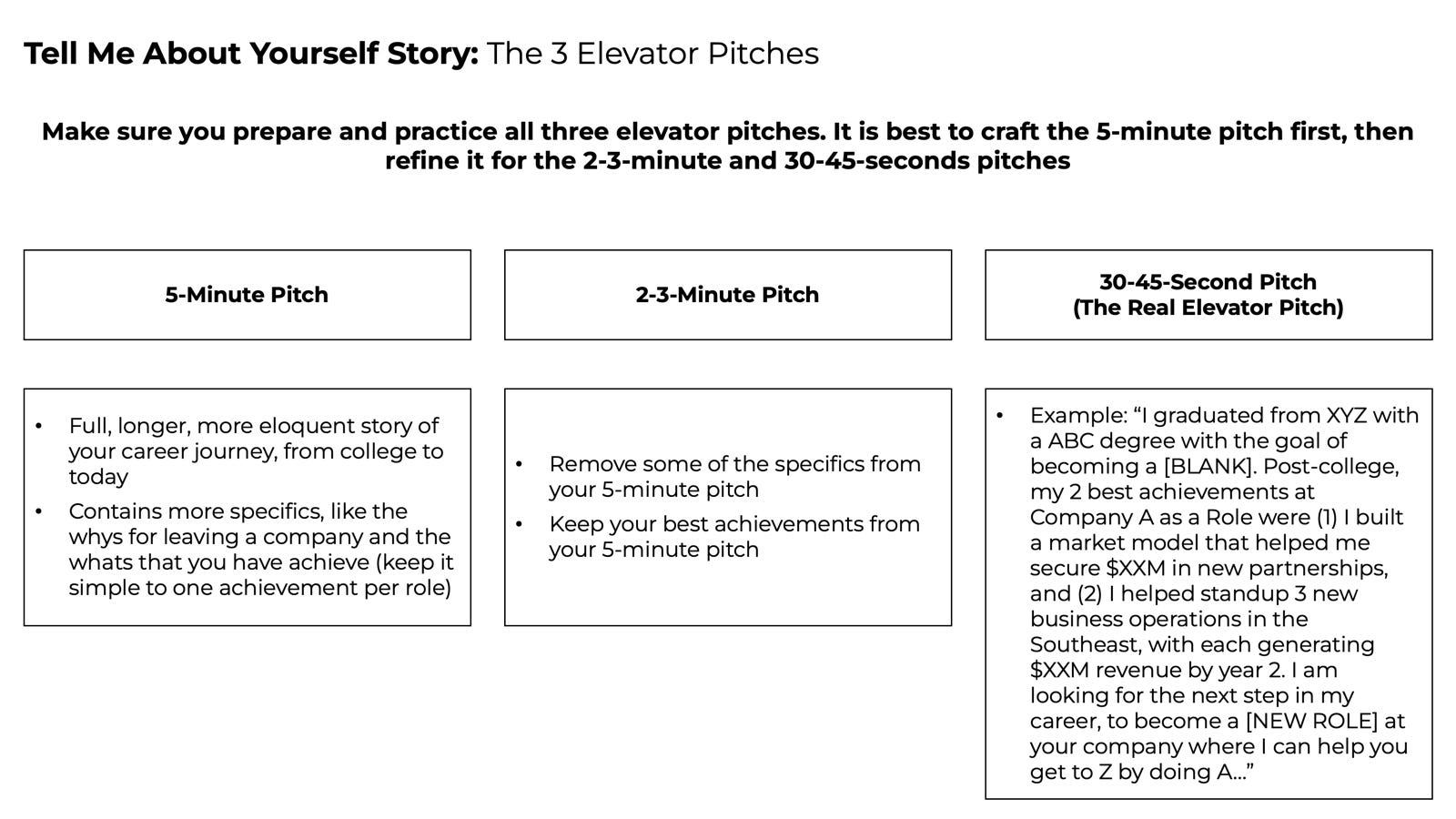
The 5-Minute Pitch
This is your deep dive. You use this when you’re in a longer interview, maybe 45 or 60 minutes, and you can sense the interviewer is relaxed and wants to hear your full story.
The 2-to-3-Minute Pitch
This is your standard, go-to version. It’s perfect for most 30-minute interviews or when you need to be concise.
The 30-to-45-Second Pitch
This is your “elevator pitch.” You’ll be surprised how often this comes up. I’ve had interviewers say, “We’re short on time, quickly summarize your career in a few words.”
You have to be ready for that.
My advice is to always start by writing the 5-minute version first. It is much easier to remove context than it is to add it later. You write the full story, and then you can strategically cut it down.
My 2-3 Minute Version
Let me walk you through an example of my own 2-3 minute pitch, so you can see how the pieces fit together.
Here’s how it sounds:
“My name is Gerome and I have over 8 years of experience working in consulting, finance, entrepreneurship, and strategy. I’ve had the opportunity to work for some of the biggest companies in the world delivering strategic insights and driving business innovations. I like to start from the early part of my career so you have a better understanding of how I got here today and why I’m speaking with you.”
“I studied engineering in undergrad and then quickly went to grad school at BU to get my Masters in Mathematical Finance. My hope was to become an investment banker one day, but I knew it was going to be a journey. I started my career in financial services in roles that let me hone my quantitative skills and crucial client-facing and presentation skills that are required in Investment Banking.”
“Once I became an Investment Banker, which people say is the pinnacle of finance, I realized I wasn’t happy. I had an entrepreneurial itch, so I left my job to start my own footwear brand. I worked on that for about two years, and when that didn’t go as planned, I knew I needed to go to Business School to package all my experiences and become a better leader.”
“But after doing my research, I noticed I was missing a key piece in my profile that many MBA students had: strategy experience. So, before even applying, I found an opportunity at a hospital as a Business Strategy Analyst, where I developed cost-optimization models that saved the hospital over $9 million. I then applied and got into Kellogg.”
“At Kellogg, I interned at McDonald’s on their Digital Marketing team, helping launch their loyalty app. Post-Kellogg, I went to L.E.K. Consulting, working on strategy projects for C-Suite executives. After two years there, I joined a digital health startup backed by a large corporation, seeing it as a great opportunity to build something impactful from the ground up.”
“But during my time there, I had a chance to reflect on what I truly wanted long-term. And it all came back to the passion I had when I started my footwear brand. And that is to be a part of the retail, apparel, and fashion industry. I love the people, the innovation, the fast pace. The only constant in that industry is change, and I find that exciting. And that is why I am talking to you today.”
What to Notice
So that’s the medium version. The longer version would have a bit more quantifiable accomplishments.
Now notice a few things.
I provide enough information for them to follow my resume, but I don’t give every single detail. I leave room for them to ask questions like, “Wow, what was it like starting a footwear brand?” or “Tell me more about that $9 million you saved the hospital.”
You are trying to sell your story and start a conversation, not bore them with a monologue.
Practice and Refine
Once you have that 5-minute story, your job is to practice and refine.
Condense it to 2 minutes. Then to 30 seconds.
You can use AI tools to help you summarize, but you must make sure it still has your voice. The only way to do that is to practice.
Read it out loud. Record yourself on camera and listen to it the next day. Does it sound natural?
And always remember K.I.S.S. Keep It Simple, Stupid. A five-year-old should be able to understand the basics of your journey.
Be Flexible
Now, for the advanced part.
As you get comfortable with your story, you need to be flexible. Be prepared to tell it chronologically, like I just did, or in reverse.
Sometimes an interviewer will say, “Just walk me through your last two roles.”
The more you internalize your Skills Vault and your narrative, the easier it will be to create these pitches on the fly.
Read the Room
And the final piece of the Narrative Advantage is awareness.
Pay attention to the interviewer’s demeanor. If you sense they’re getting bored or looking at the clock, be ready to cut a few things out and get to the end faster.
Having a sense of people’s reactions and being able to adapt your story in the moment is a superpower.
Your Task
So here’s your task.
I want you to write out the first draft of your 5-minute “Tell Me About Yourself” pitch. Pull from your resume, pull from your Skills Vault.
Don’t worry about perfection. Just get the full story down on paper.
Now that you have your core story, your opening argument, it’s time to prepare for the cross-examination on the toughest parts of your journey. In the next post, we’re going to do just that. We’ll learn how to address career gaps and pivots directly, turning potential points of weakness into moments of strength and intention.
I’ll see you there.
Next up: The P.O.W.E.R. Framework for addressing gaps and pivots
Here is the complete career playbook (all 26 posts with real-world interview, resume, and career examples) for anyone who is pivoting roles, industries, about to graduate, stuck in their current path, not sure what to do next, etc.