

Stop Reading Job Descriptions Like a Rejection Letter
How to decode what companies actually want (and why you're more qualified than you think)

Welcome back. In the last post, we did the hard work of defining your North Star. That intersection of role, industry, and culture that you can get genuinely excited about.
Having that target is everything.
Now, with that destination in mind, it’s time to learn how to read the maps.
And for us, the map is the job description ("JD”).
What Usually Happens
Let’s be honest about what usually happens.
You find a JD that looks interesting. You start reading. And then you hit the “Requirements” section.
Your stomach drops.
You see a bullet point, a piece of software, or a number of years of experience you don’t have. And that Outsider Complex starts screaming in your ear.
You think, “Nope, not for me. I would be wasting my time submitting my resume.” And you close the tab.
You just disqualified yourself from the race before it even started.
That’s because you’re reading the JD like a pass/fail test. A checklist.
Today, we are going to fundamentally change that.
We’re going to stop reading it as a list of reasons you can’t get the job, and start reading it as a document that reveals the company’s pain points and tells you exactly what they’re looking for.
The Mindset Shift
The mindset shift is this:
Stop asking, “Do I have everything on their checklist?”
Start asking, “What problem is this company trying to solve with this role, and how does my unique mosaic of skills solve it for them?”
To do that, I use a three-step decoding process. It’s how I find the story behind the bullet points.
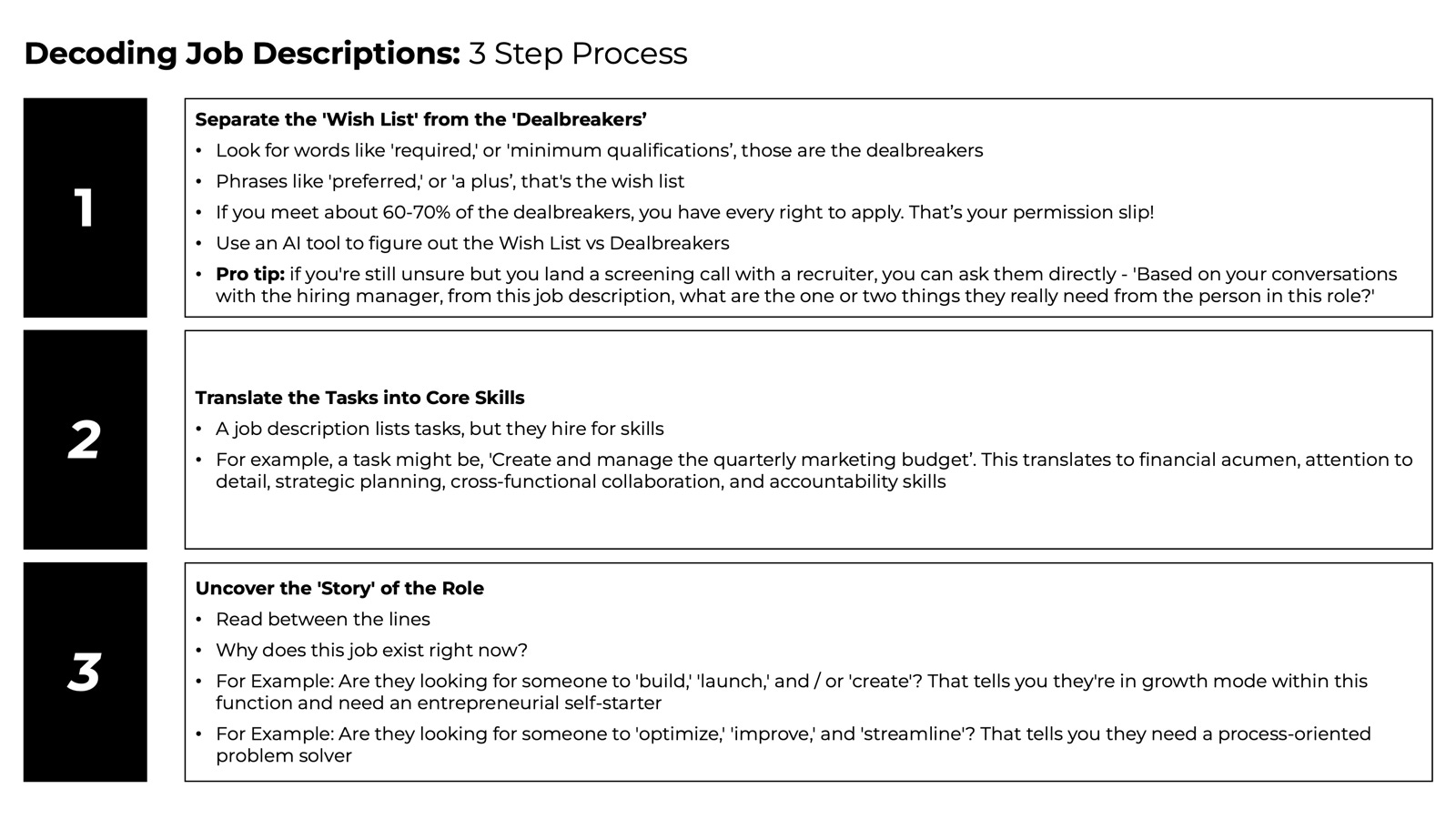
Step 1: Separate the “Wish List” from the “Dealbreakers”
Hiring managers create a job description for their absolute dream candidate. A unicorn that probably doesn’t exist.
Your job is to figure out what’s truly a dealbreaker.
Look for words like “required” or “minimum qualifications.” Those are the dealbreakers. Phrases like “preferred” or “a plus.” That’s the wish list.
If you meet about 60 to 70% of the dealbreakers, you have every right to apply. That’s your permission slip.
Now, if you’re on the fence trying to figure it out, use an AI tool like ChatGPT or Gemini. Just copy and paste the job description and ask it, “What are the dealbreaker requirements in this role?”
It won’t be 100% accurate, but it gives you a good starting point.
And here’s a pro tip that we will discuss further during a future post on interviewing: if you’re still unsure but you land a screening call with a recruiter, you can ask them directly.
Towards the end of the call, when they ask if you have questions, say something like: “Based on your conversations with the hiring manager, from this JD, what are the one or two things they really need from the person in this role?”
Their answer is gold.
Step 2: Translate the Tasks into Core Skills
This is the most important step.
A JD lists tasks, but they hire for skills.
For example, a task might be, “Create and manage the quarterly marketing budget.”
The underlying skills are financial acumen, attention to detail, strategic planning, cross-functional collaboration, and accountability.
A career changer might not have managed that exact budget, but you absolutely have those skills from a different context.
Step 3: Uncover the “Story” of the Role
Read between the lines. Why does this job exist right now?
Are they looking for someone to “build,” “launch,” and “create”? That tells you they’re in growth mode within this function and need an entrepreneurial self-starter.
Or are they looking for someone to “optimize,” “improve,” and “streamline”? That tells you they need a process-oriented problem solver.
The story tells you what kind of character they need you to be.
The Case Study
Now, here’s the case study. My first big interview for a competitive internship at General Electric when I was a sophomore in college.
My main experience? A cashier at Babies R Us.
The job description was full of corporate language, and a key “dealbreaker” skill was “Entrepreneurial Drive.”
My Outsider Complex was having a field day. “Entrepreneurial Drive? I scanned and rang up diapers! What are you going to talk about?”
But I did the translation.
I asked myself, what does entrepreneurial drive really mean at its core? To me, it means being proactive, spotting opportunities, taking initiative, and having the resilience to handle tough situations.
So in the interview, I didn’t hide from my experience.
I told them, “Look, at Babies R Us, I paid attention to what people were buying, and I was proactive about trying to upsell. But more than that, my stakeholders were brand new parents. Stressed, sleep-deprived, and sometimes angry. My job was to de-escalate their frustration, listen to their needs, and find a solution that made them feel valued.”
I connected my mosaic piece directly to their need for someone with resilience and initiative.
I vividly recall, after getting the offer, the recruiter telling me: “You did a fantastic job at selling your Babies R Us experience. I know exactly what a cashier does, but you made it sound completely different.”
That’s the power of really understanding what the hiring manager is looking for.
Your Task
So that’s your mission. Here’s your task for this post.
Go find 2 or 3 job descriptions that align with your North Star. Look at what those dealbreaker skills are. Write them down, and start thinking about how you can fit your past experiences into those buckets.
And use AI to help you. You can even give an AI tool the dealbreaker skills and your resume, and ask it to find potential connections.
Use these tools to your advantage. Everyone else is, why shouldn’t you?
This exercise will prove to you that a job description isn’t a wall designed to keep you out. It’s an invitation to tell your story.
It will also be extremely helpful down the road when you start getting interviews and need to review the JD for the interview prep.
Take some time with this. In the next post, we’ll build on this and create a master inventory of all your most powerful transferable skills.
I’ll see you there.
Next up: Building your Skills Vault

Here is the complete career playbook (all 26 posts with real-world interview, resume, and career examples) for anyone who is pivoting roles, industries, about to graduate, stuck in their current path, not sure what to do next, etc.