

They Just Sent You a Case Study. Here's How Not to Panic
The 4-step playbook I used in 40+ final-round presentations (and why structure matters more than your answer)

Your inbox pings. It’s the recruiter. Subject line: “Next Steps - Case Study Assignment.”
Your stomach drops.
They want a full presentation. Due in 72 hours. The prompt is three paragraphs of dense business jargon. There’s an Excel file attached with 47 tabs.
Welcome to the final round.
This Is Not a Test. It’s an Audition.
Let me reframe this for you right now.
A case study is not a test. It’s an audition.
They’re not just testing your brain. They’re auditioning what it would be like to work with you. Can you take a messy, ambiguous problem and present a clear, confident point of view?
That’s the real question.
Having gone through probably 40 of these final-round cases and presentations myself over the years, I’ve learned that there’s a playbook.
And the core philosophy is simple: The “how” is more important than the “what.”
Your final answer is often less important than the clear, logical structure you used to get there. They want to see how your mind works.
The 4-Step Playbook
So let’s start with the take-home case. Here’s the four-step playbook I use every single time.
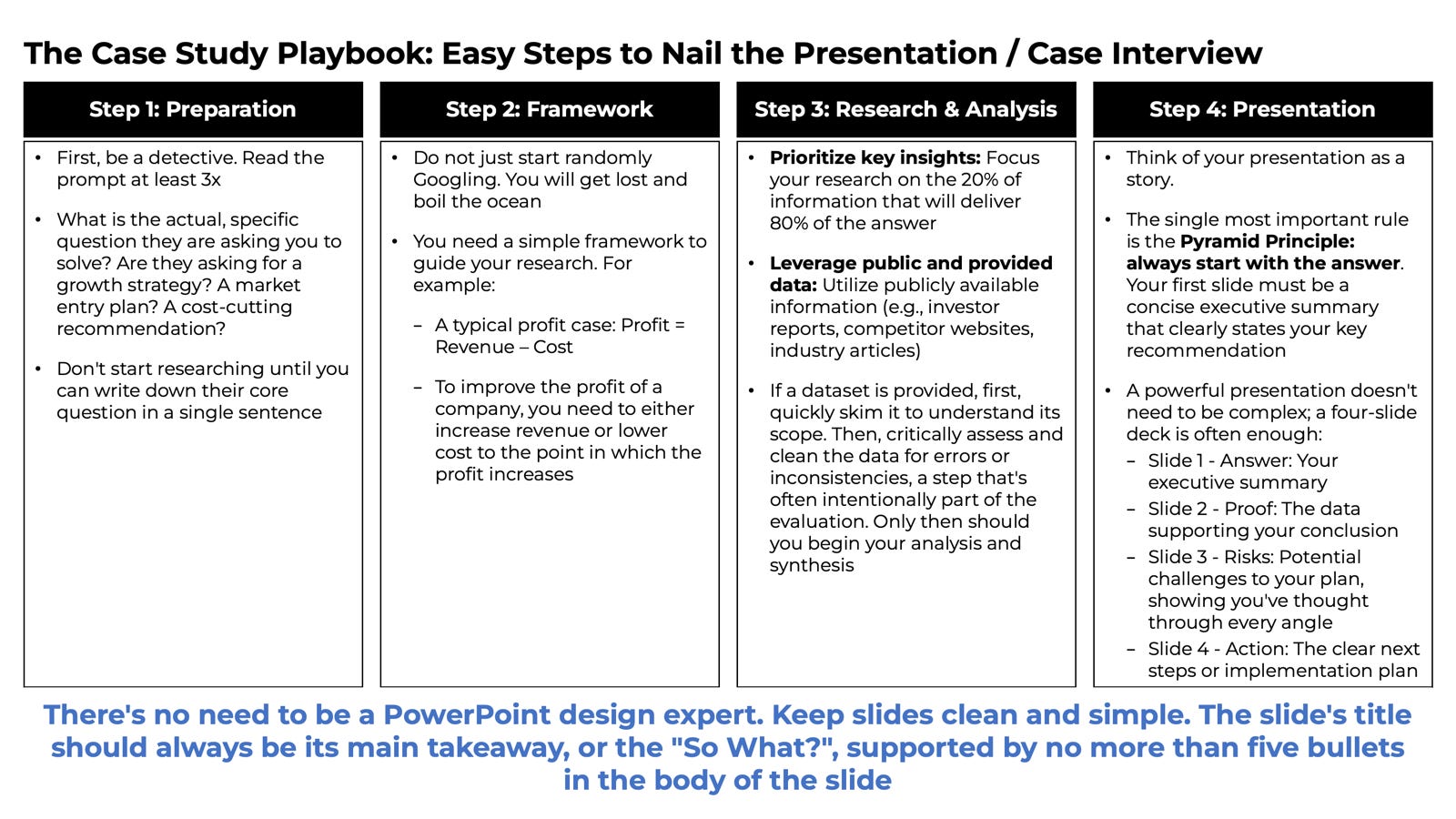
Step 1: Deconstruct the Prompt
Before you do any work, you need to be a detective.
Read the prompt they send you three times. What is the actual, specific question they are asking you to solve?
Are they asking for a growth strategy? A market entry plan? A cost-cutting recommendation?
Don’t start researching until you can write down their core question in a single sentence.
Step 2: Structure Your Thinking
Do not just start randomly Googling. You will get lost and boil the ocean.
You need a simple framework to guide your research.
For example, look at a typical profit case:
Profit is just Revenue minus Cost. (P = R - C)
So to improve the profit of a company, you need to either increase revenue or lower cost to the point in which the profit increases. It’s a simple tree.
Another example, my go-to for almost any growth strategy case is a simple issue tree: “To grow, this company can either A) Grow in its core business, B) Expand into adjacent markets, or C) Acquire a competitor.”
That’s it. That simple structure now guides all of my work. I’m not just searching for facts. I’m searching for evidence for one of those three buckets.
Step 3: Execute with the 80/20 Rule
You have limited time. You cannot become the world’s leading expert.
Focus on the 20% of the research that will get you 80% of the way to a confident answer.
Use public information. Their investor reports, competitor websites, articles about the industry.
Now, sometimes they will send you data. If they do, here are some important things you need to do.
First, skim through the data that is given. Majority of the time, they overwhelm you with data, so do not start answering any questions yet.
Consider the prompt and your framework, and start to pinpoint which data sets you think are necessary.
Once you have those pinpointed, you need to CLEAN the data. This is super important.
Companies are often checking for this exact thing. They intentionally send data that has blanks or errors. Clean it up and note what exactly you cleaned.
Then you can start analyzing the data and synthesizing your outputs.
Step 4: Build the Narrative
This is where your narrative skills come in. Your presentation is a story.
The most important rule is the Pyramid Principle: start with the answer first.
Your very first slide should be your executive summary. For example, “For Company X to reach a 5% increase in profit by 2030, our recommendation is to launch Product A at a price of $15/unit and a cost of $3/unit.”
And then the rest of the executive summary provides the key takeaways from the framework you used to solve the problem.
A simple, killer deck can be just four slides. We do not need a title slide because it does not offer any value for an interview.
Slide 1: Executive Summary with your answer
Slide 2: Your supporting data
Slide 3: Potential risks to your plan (this shows you’re a critical thinker)
Slide 4: Next steps or implementation plan
For the slides, you do not have to be a PowerPoint master. Keep it simple. Always have the “So What?”, the key takeaway, as the title of the slide, and then have 3 to 5 bullets to support it.
Remember, K.I.S.S. Keep It Simple, Stupid.
The Delivery
Now for the delivery.
At the beginning, I always say, “I am going to walk you through my recommendation, but please stop me at any time if you have any questions or concerns.”
When you’re presenting, remember it’s a conversation, not a lecture. Don’t just read your slides word-for-word.
Start with the “So What” of the slide and provide the key takeaways. Make eye contact. Pause.
If they challenge you, don’t get defensive. The best response is, “That’s a great point.”
If you need time to answer, say, “Let me take a minute to jot down my thoughts.”
And if you do not have the answer at all, say “That is a great point, but given the current information, I can’t provide a solid response. However, my hypothesis is that Product B could be an option, and I would work with your customer data team to get the following data points to validate that.”
It shows you have an idea on how to solve it and that you’re collaborative.
The Secret Weapon: The Appendix
And a final pro tip for the take-home: the appendix is your best friend.
Have extra slides in an appendix with deeper data. If they ask a tough, detailed question, you can say, “That’s a great question, I actually have a slide on that in the appendix.”
This makes you look incredibly prepared.
The Live Case
Now, sometimes they give you cases on the fly, in the middle of an interview.
There are hundreds of thousands of resources for these types of cases online. This is basically the training new MBAs go through for consulting recruiting.
But I want to highlight a few things that have helped me.
When they are stating the prompt, take as many notes as possible. Then, after they’ve stated it, summarize the prompt back to them quickly:
“So it seems like Company X wants to know if they should launch either Product 1 or 2 to reach the CEO’s goal of $10M by next year. Is that correct?”
The interviewer will confirm.
The prompt will almost always have limited information. That’s because they want you to ask the right questions. So you can follow up with broad questions: “Great, so what are the two products?” or “Is the $10M goal revenues or profits?”
From here, you will then say, “Great, I have some information to get started. Let me take a minute or two to jot down my ideas and create a framework.”
Then you take that time to come up with a simple framework. I like to think of frameworks as a project plan. Each bucket in the framework is a workstream for that project.
After one or two minutes, you quickly walk them through the framework, but you don’t have to say everything. Just give them the “So What” behind each workstream and why it’s important.
Then you say, “Great, I’d like to start with analyzing the potential revenues. Has the team set prices for Products 1 and 2?”
From here, a series of steps will follow. At the end of the day, they just want to see how you approach problems, that you are structured, can tell a cohesive story, and that you are not defensive or difficult to work with.
Your Task
Here’s your task. Go online and find a sample “consulting strategy case study prompt.”
Don’t solve it. Just practice the first two steps.
First, write down the single, core question the prompt is asking. Second, create a simple, 3-bucket framework for how you would start to solve it.
This exercise will train you to bring structure to ambiguity, which is the core skill they’re testing for.
In the next post, we’ll talk about navigating the human dynamics of the final rounds: handling multiple interviews in one day and sitting in front of a panel.
I’ll see you there.
Next up: Surviving the interview marathon (and the dreaded panel)
Here is the complete career playbook (all 26 posts with real-world interview, resume, and career examples) for anyone who is pivoting roles, industries, about to graduate, stuck in their current path, not sure what to do next, etc.