

What to Ask When They Say 'Do You Have Any Questions for Me?
The 3 tiers of questions that prove you're prepared, curious, and already thinking like an employee

The interview is winding down. You can feel it.
They glance at the clock. They close their notebook. And then they lean back and say, “So, what questions do you have for me?”
Most people relax here. They think the hard part is over.
It’s not.
This Is Not a Formality
Let me be clear: this is not a formality.
The questions you ask can make or break a close decision. A weak question, or worse, saying “No, I think you covered everything,” is a massive red flag.
It signals a lack of curiosity and preparation.
This is your last chance to shine, to gather intelligence, and to decide if you actually want to work there.
To do this effectively, I like to group my questions into three distinct categories. It helps me make sure I’m covering all my bases.
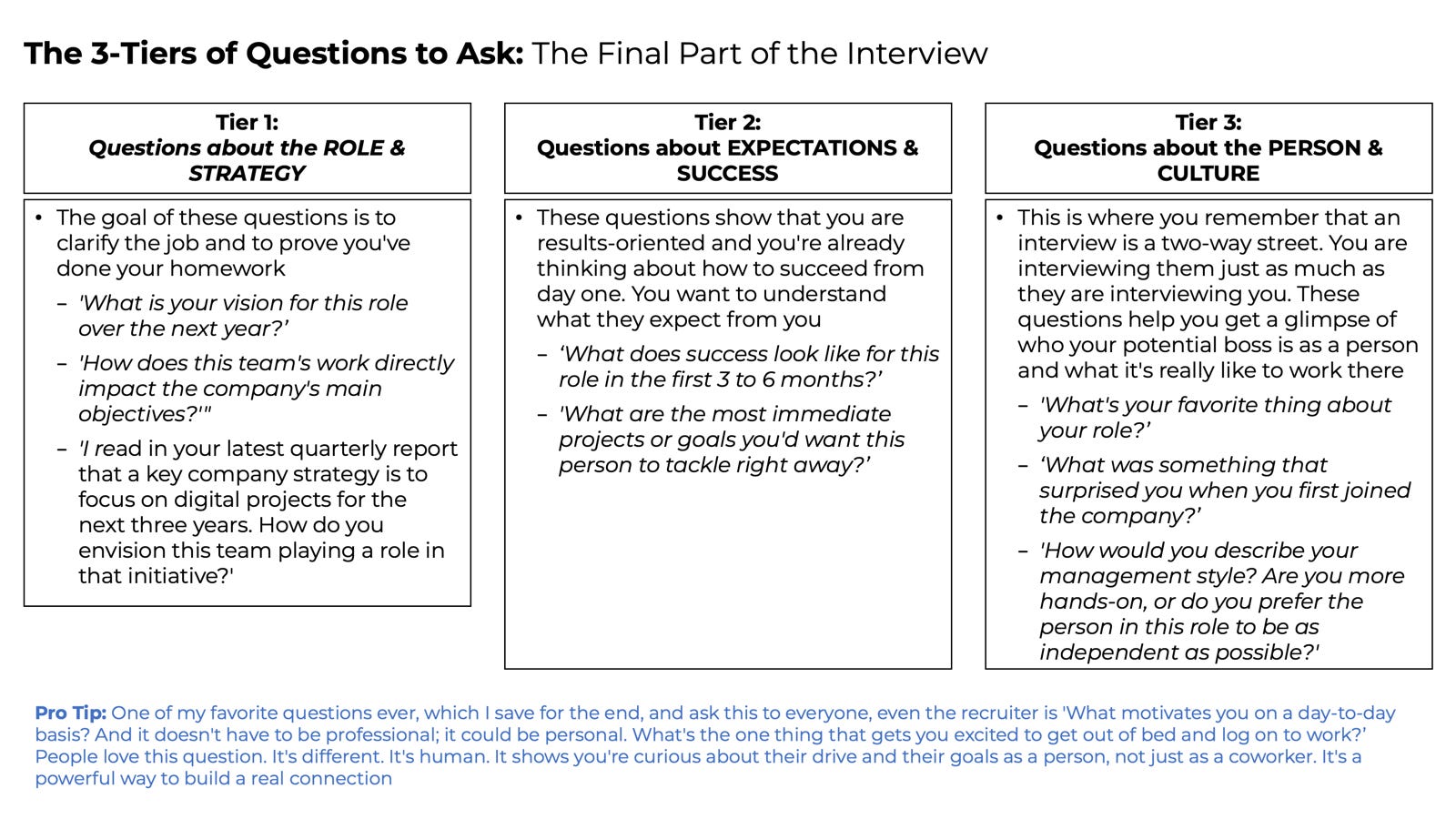
Tier 1: Questions About the ROLE & STRATEGY
The goal of these questions is to clarify the job and to prove you’ve done your homework.
You want to understand how the team fits into the bigger company picture.
You can ask things like:
“What is your vision for this role over the next year?”
“How does this team’s work directly impact the company’s main objectives?”
And this is your prime opportunity to show off your research.
You can ask a question like, “I read in your latest quarterly report that a key company strategy is to focus on digital projects for the next three years. How do you envision this team playing a role in that initiative?”
This shows you’re already thinking like an employee, not just a candidate.
I’ve already mentioned this before, but I’m going to reiterate it again here. A great question specifically for the initial recruiter screen is this:
“Based on your conversations with the hiring manager, what are the one or two most crucial things they need this person to accomplish?”
This helps you get insider information you can use in later rounds.
Tier 2: Questions About EXPECTATIONS & SUCCESS
These questions show that you are results-oriented and you’re already thinking about how to succeed from day one.
You want to understand what they expect from you.
You can ask things like:
“What does success look like for this role in the first 3 to 6 months?”
“What are the most immediate projects or goals you’d want this person to tackle right away?”
These questions signal that you are focused on delivering value.
Tier 3: Questions About the PERSON & CULTURE
This is where you remember that an interview is a two-way street.
You are interviewing them just as much as they are interviewing you.
These questions help you get a glimpse of who your potential boss is as a person and what it’s really like to work there.
You can ask:
“What’s your favorite thing about your role?”
“What was something that surprised you when you first joined the company?”
“How would you describe your management style? Are you more hands-on, or do you prefer the person in this role to be as independent as possible?”
My Favorite Question Ever
Now, I want to give you one of my favorite questions ever, which I save for the end, and ask this to everyone, even the recruiter.
It’s a final pro tip.
I always ask this:
“What motivates you on a day-to-day basis? And it doesn’t have to be professional, it could be personal. What’s the one thing that gets you excited to get out of bed and log on to work?”
People love this question. It’s different. It’s human.
It shows you’re curious about their drive and their goals as a person, not just as a coworker.
It’s a powerful way to build a real connection.
Your Task
So here’s your task. I want you to build your own question bank.
Before your next interview, I want you to write down at least two questions for each of the three tiers: the Role, the Expectations, and the Person.
Have them ready in your notebook.
You’ve Completed Advanced Strategies
And with that, you have officially completed this phase.
You’ve learned how to handle the case study, navigate the superday, and now, how to ask brilliant questions.
This completes the core of our advanced strategies.
Great, great work.
I’ll see you in the next phase.
Next up: Post-interview strategy and negotiation
Here is the complete career playbook (all 26 posts with real-world interview, resume, and career examples) for anyone who is pivoting roles, industries, about to graduate, stuck in their current path, not sure what to do next, etc.