

Your Resume Is a Marketing Document, Not a History Report
How to craft a resume that sells your future, not just lists your past

Welcome to a new phase. We have done some incredibly important work to get here.
You have your North Star. You’ve learned how to decode job descriptions. And you’ve built your Skills Vault, that arsenal of your best stories and achievements.
You have all the raw materials.
Now it’s time to build. We’re going to craft your narrative, and the first and most critical piece of that is your resume.
The Anxiety
For a career changer, the resume is often the source of the most anxiety.
The number one thing I hear is, “My experience is all over the place. How do I make this make sense to a recruiter who’s going to look at it for six seconds?”
That’s a real fear. And it’s a valid one if you think about your resume the way most people do.
But before we even talk about the content and the story of your resume, we need to talk about the first thing that’s going to read it.
And that is the Applicant Tracking System, or ATS.
The Robot You Have to Beat First - ATS
You have to understand, companies receive hundreds, sometimes thousands, of resumes for a single job posting.
If you don’t believe me, just look at the job listings on LinkedIn. Within minutes, new jobs receive over 100 applicants. Recruiters just do not have the bandwidth to go through every single one.
So they rely on a filtering system, the ATS, to scan your resume and bubble up the “top candidates” that most likely fit the job description.
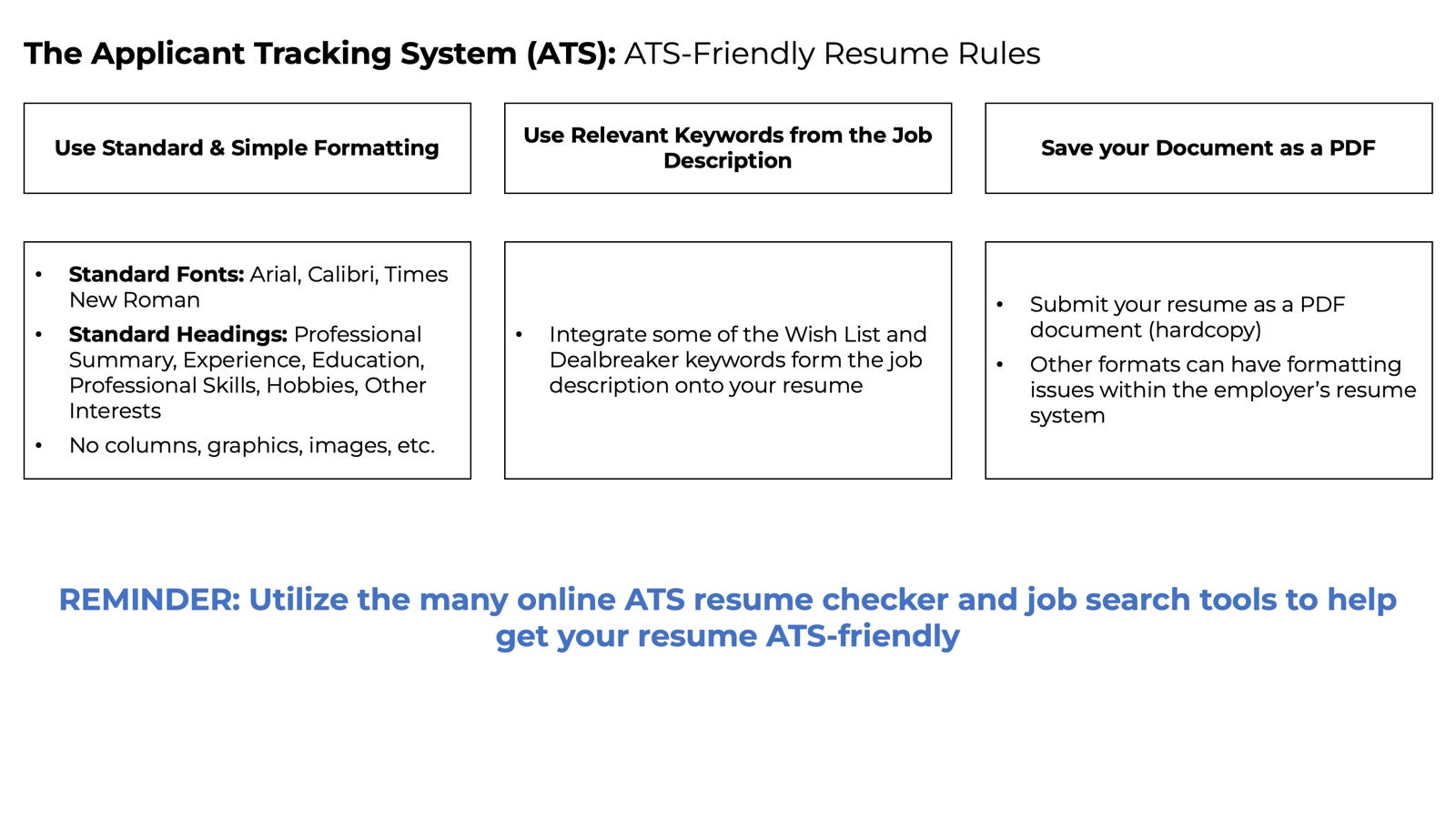
This is extremely important: you must have a resume that is ATS-friendly.
Your first goal is to beat this automated system so that your story actually lands on a recruiter’s lap.
To do that, you need to follow a few simple, technical rules.
Rule 1: Use Standard and Simple Formatting
This means standard fonts like Arial, Calibri, or Times New Roman. Use standard headings like “Professional Experience” and “Education.”
No fancy columns, graphics, or images that can confuse the system.
Rule 2: Use Relevant Keywords from the Job Description
This is why our work in the last posts on decoding job descriptions was so important. The ATS is scanning for those keywords, so make sure they’re naturally integrated into your resume.
Rule 3: Save Your Document as a PDF
I highly prefer PDF-only when submitting, because any other format (e.g., .docx, .pages, etc.) can have its formatting changed by the system. You don’t want to risk that.
A PDF is a hardcopy. It locks everything in place.
Now, there are many resources online that describe how to make ATS-friendly resumes in more detail. There are even tools out there that allow you to upload your resume and the job description, and they’ll score how well you match and suggest changes.
It is extremely important that you understand this before you submit a single application.
The Philosophy That Changes Everything
Okay, so once you have the technical format right to get past the robot, now we can focus on the strategic part: how to write a resume that convinces the human.
This is where we get into our single most important philosophy for this post.
You need to burn this into your brain: Your resume is not a history report. It is a marketing document.
A history report includes everything that ever happened. A marketing document is designed to do one thing: sell a product for a future use. It only includes the features and benefits relevant to the customer.
You are the product. The recruiter is the customer. The job is the future use.
Every single word on your resume must be engineered to convince that recruiter that you are the best solution to their problem.
This philosophy gives you permission to be ruthless in your editing.
How to Build a Resume That Markets You
So how do we build a resume that markets you for a pivot?
We use a structure that tells your story for you, right from the top
First: The Professional Summary
This is the most valuable real estate on your resume, especially for us.
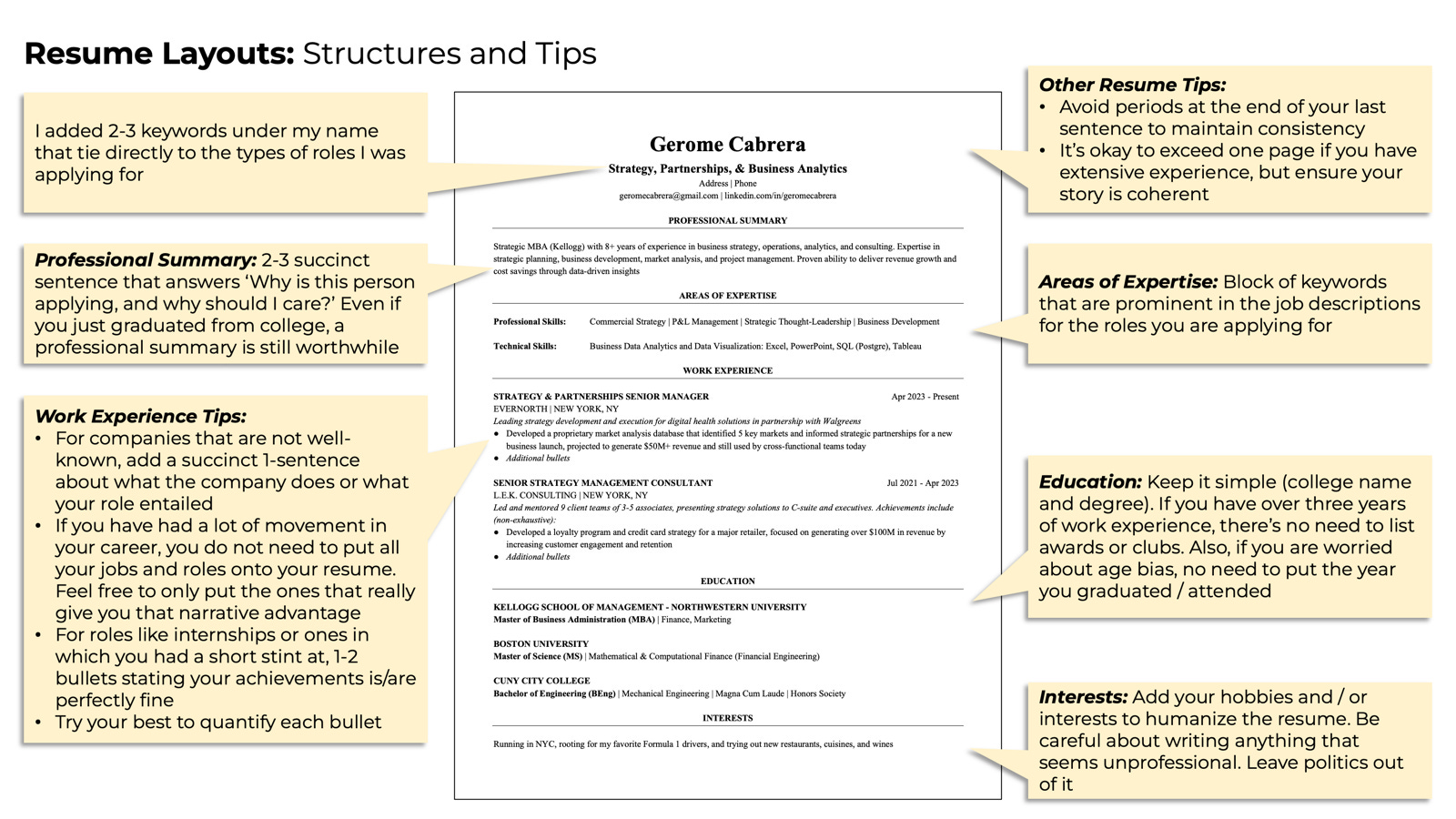
It’s a 2 to 3 sentence paragraph at the top that immediately answers the recruiter’s biggest questions: “Why is this person applying, and why should I care?”
It’s your thesis statement.
For example, when I was pivoting from healthcare to retail, my summary said something like this:
“Strategic MBA from Kellogg with 8+ years of experience in business strategy, operations, and consulting. Proven ability to deliver revenue growth and cost savings through data-driven insights. Seeking new opportunities within the retail space.”
Instantly, the recruiter gets it.
And trust me on this. This top section is critical. A few years ago in consulting, I helped recruit MBA candidates. I had to sift through hundreds of resumes, and after a while, you start to see patterns in the professional summary for the best candidates that made the “yes” pile.
Recruiters are overwhelmed, and this top section is your hook.
Second: The “Key Skills” or “Areas of Expertise” Section
Right below your summary, you need a block of keywords. This is for the human scanner and the computer algorithms.
You pull these skills directly from your Skills Vault and the “dealbreaker” skills from your target job descriptions.
I like to break it down into two categories. For me, it looked like this:
Professional Skills: Commercial Strategy | P&L Management | Strategic Thought-Leadership | Business Development
Technical Skills: Business Data Analytics and Visualization: Excel, PowerPoint, SQL, Tableau
Third: The Professional Experience
Here’s the key: every bullet point must be an achievement, not a responsibility.
Don’t tell them what you did. Tell them what you accomplished.
You’re going to pull your stories directly from your Skills Vault. Context, Action, and a quantifiable Result.
The best thing to do is use the “Split-Screen Method.” Have a target job description on the left side of the screen, and your resume on the right.
For every bullet point you write about a previous role, ask youself, “How can I frame this achievement using the language they use in their JD?”
It’s all about translation.
A pro tip for this section, if you worked for a company that isn’t well-known, or had a role that isn’t obvious, write one pithy sentence right under the title to give context.
For example, for my role at that healthcare startup, my one-sentence description was: “Leading strategy development and execution for digital health solutions in partnership with Walgreens.”
This immediately hits on “strategy” and connects it to a well-known retail company.
You Don’t Need to List Everything
And one last thing about Professional Experience. And this goes right back to the “your resume is a marketing document, not a history report” philosophy.
You do not need to put down every single job you’ve ever had if it’s not related to your North Star.
Let me give you my own example. My career path is complicated.
RBS > KPMG > Investment Banking > Footwear Brand > a temp job at Credit Suisse > Hospital Strategy > Business School > L.E.K. Consulting > Healthcare Startup.
That is a lot of movement to list on one resume.
So I made a strategic decision. I removed the things I wasn’t excited to speak on. For me, that was RBS, KPMG, and the temp job at Credit Suisse.
Even though I worked hard to get those jobs, they didn’t have the stories I wanted to tell for my pivot into retail. So I left them off.
And if a recruiter or hiring manager had asked about any gaps, which by the way they never did, I was fully prepared to talk about them. But it never came up.
Fourth: Education
Keep it simple. If you have over three years of work experience, there’s no need to list awards or clubs. Just the school and the degree.
And here’s another tip: you don’t need to put the years you attended. Look, age bias is real sometimes. That’s something you can’t control, so why not just avoid giving them a reason to bucket you?
It’s okay to leave it off.
Finally: Hobbies or Interests
At the bottom, have a one-liner for your Hobbies or Interests. People want to see that you’re a human being who enjoys things.
Obviously, be careful here. Don’t write anything that could be a red flag or be seen as “weird.” Keep it simple and relatable.
Your Task
So here’s your task for this post. We’re going to build the most important part of your new resume: the Professional Summary and the Key Skills section.
First, write that 2 to 3 sentence Professional Summary. Who are you, what value do you bring, and where do you want to go?
Second, create that “Key Skills” section with your top keywords. Maybe even breaking them down into Professional and Technical. Pull them from the job descriptions you analyzed.
This is the first thing a recruiter sees. If you get this right, you will have earned their attention.
Take your time with this. Remember, you’re not a historian of your past. You are the marketer of your future.
In the next post, we’re going to take the story we’ve started to write here and bring it to life. We’ll craft the most important spoken part of your narrative: your “Tell Me About Yourself” pitch.
I’ll see you there.
Next up: Mastering “Tell Me About Yourself”

Here is the complete career playbook (all 26 posts with real-world interview, resume, and career examples) for anyone who is pivoting roles, industries, about to graduate, stuck in their current path, not sure what to do next, etc.