

Build Your Skills Vault (So You Never Freeze in an Interview Again)
How to create a master inventory of your most powerful stories and stop scrambling for answers

Welcome back. We’ve made good progress. We defined your North Star, and we’ve learned how to decode job descriptions. Not as checklists, but as documents that reveal a company’s and hiring manager’s true needs.
You’ve already started connecting your past experiences to those needs.
Now we’re going to take that process to the next level.
The Problem
I want to talk about a problem I see all the time.
Someone gets into an interview. The hiring manager says, “Tell me about a time you showed leadership.” And their mind goes completely blank.
They freeze.
They know they’ve done it, but they can’t access the story in that high-pressure moment. They end up giving a weak, generic answer.
That happens because their best stories are scattered in their memory. They haven’t done the work to inventory their own value.
Today, we are going to solve that problem for good.
We are going to build your “Skills Vault.”
What Is a Skills Vault?
Think of this as your personal arsenal of career stories and achievements.
It’s a single document. Your source of truth. That you will use to build your resume, prepare for every interview, and articulate your value with confidence.
When you’ve done this work, you’re not trying to remember your stories in an interview. You’re ready to tell them.
So how do we build it?
It’s a three-step process.
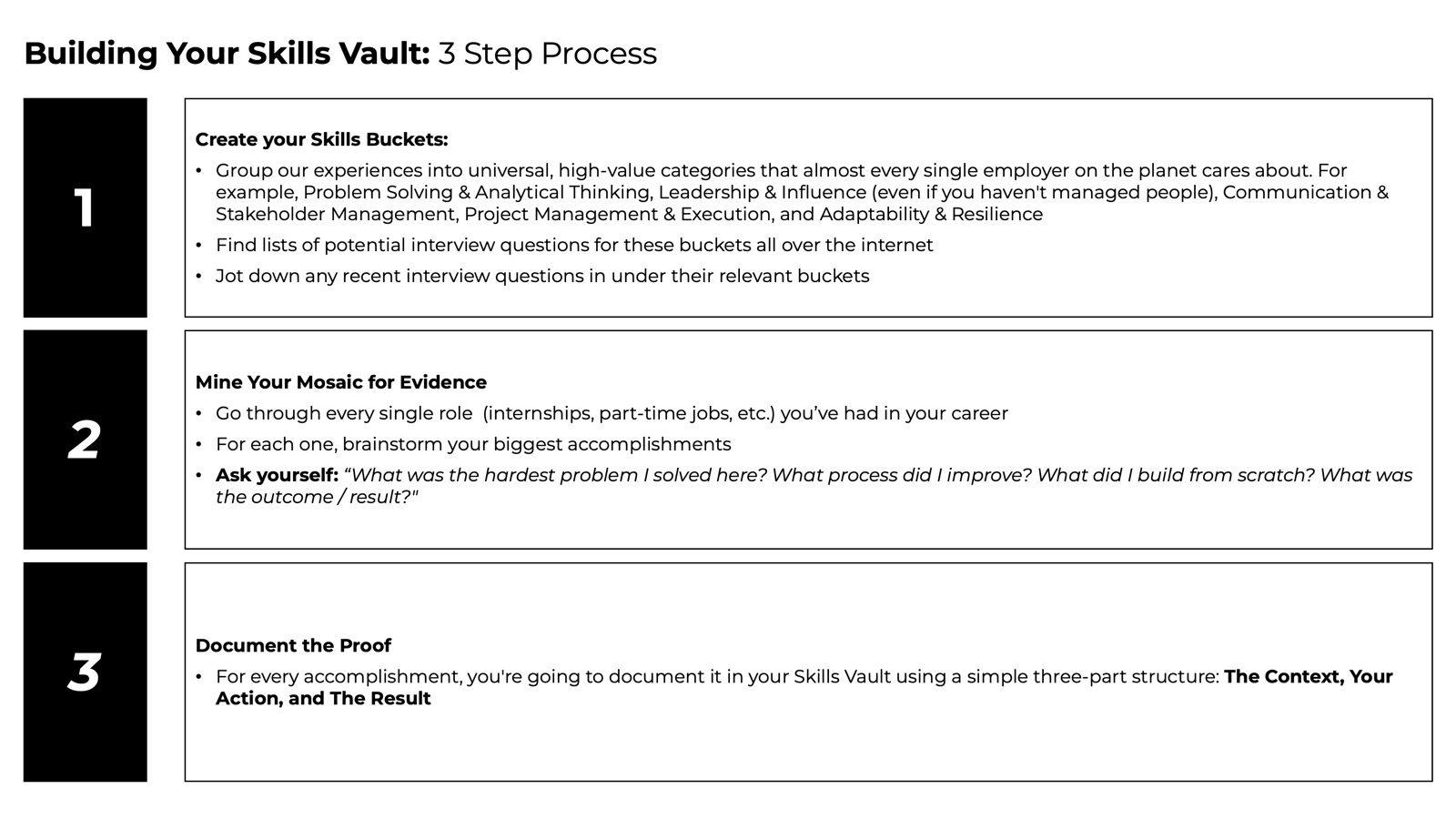
Step 1: Create Your “Skill Buckets”
Instead of just listing random skills, we’re going to group our experiences into universal, high-value categories that almost every single employer on the planet cares about.
These are our buckets.
Think of buckets like:
Problem Solving & Analytical Thinking
Leadership & Influence (even if you haven’t managed people)
Communication & Stakeholder Management
Project Management & Execution
And finally, a crucial one for career changers: Adaptability & Resilience
You can find lists of potential interview questions for these buckets all over the internet. I want you to gather some of those.
Also, if you can think of any recent questions that recruiters have asked you, jot those down.
Having this list of real questions next to your stories is going to be incredibly helpful.
Step 2: Mine Your Mosaic for Evidence
Now, you’re going to go through every single role on your resume.
And I mean every role. From the internship, to the retail job, to the consulting gig, to the startup you launched.
For each one, brainstorm your biggest accomplishments.
Ask yourself: What was the hardest problem I solved here? What process did I improve? What did I build from scratch?
Get the raw material down.
Step 3: Document the Proof
This is where we turn a vague memory into a powerful story.
For every accomplishment, you’re going to document it in your Skills Vault using a simple three-part structure:
The Context, Your Action, and The Result.
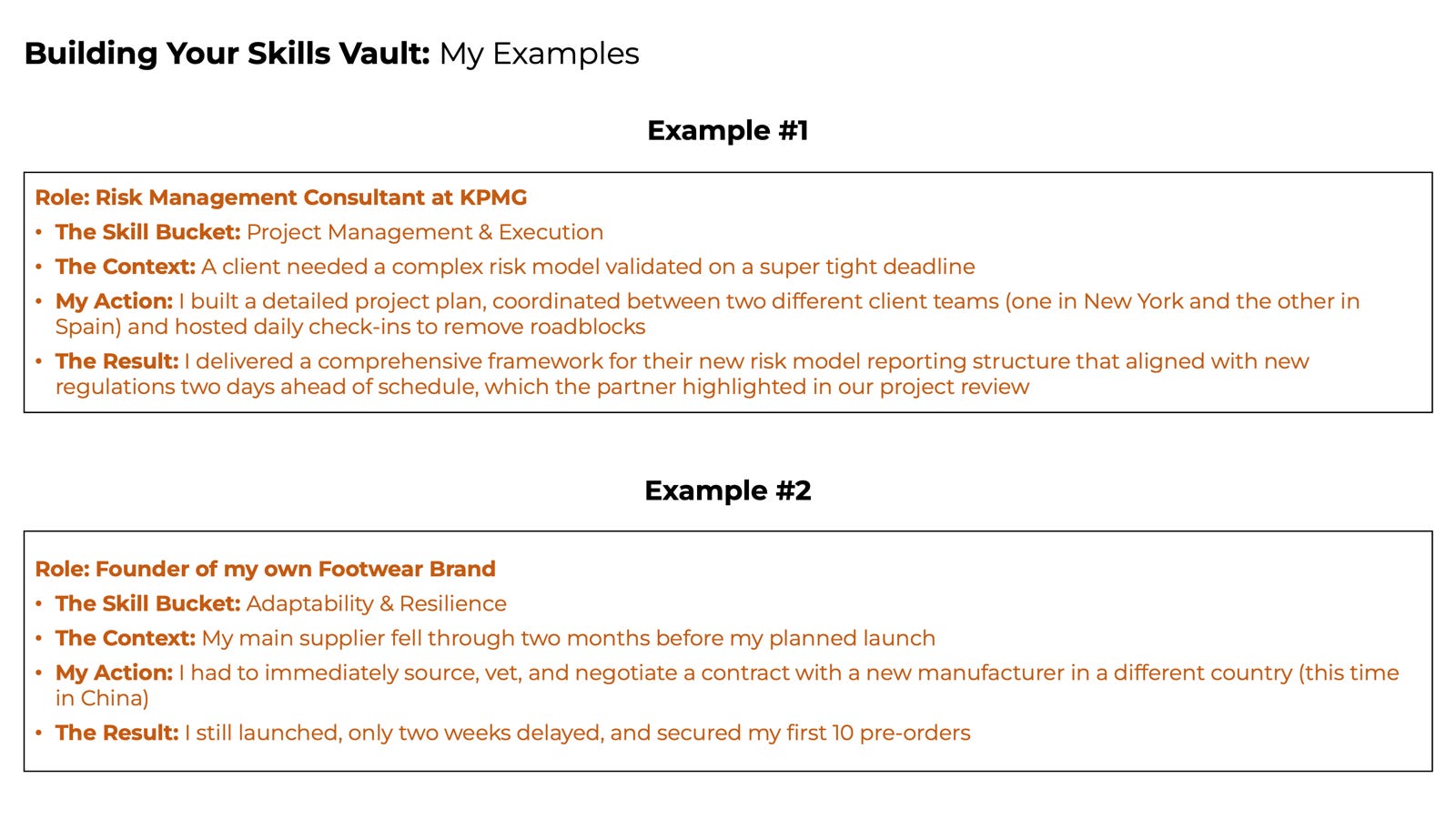
Let me show you how this works with two examples from my own vault.
Example 1: KPMG
The Skill Bucket: Project Management & Execution
The Context: A client needed a complex risk model validated on a super tight deadline.
My Action: I built a detailed project plan, coordinated between two different client teams (one in New York and the other in Spain), and hosted daily check-ins to remove roadblocks.
The Result: I delivered a comprehensive framework for their new risk model reporting structure that aligned with new regulations two days ahead of schedule, which the partner highlighted in our project review.
See how that works? It’s a mini-story with a tangible outcome.
But this doesn’t just work for corporate jobs. Let me show you my footwear brand example.
Example 2: My Footwear Brand
The Skill Bucket: Adaptability & Resilience
The Context: My main supplier fell through two months before my planned launch.
My Action: I had to immediately source, vet, and negotiate a contract with a new manufacturer in a different country. This time in China.
The Result: I still launched, only two weeks delayed, and secured my first 10 pre-orders.
The structure is the same. It works for every piece of your mosaic.
Your Task
So here is your task, and it’s the most important one we’ve covered so far.
Create a new document. Title it “My Skills Vault” or something along those lines.
List out those 4 or 5 skill buckets and start gathering some related interview questions that fit into them.
Your goal is to go through your past and find at least one powerful story for each bucket that can help answer those questions.
And let me be clear: it is perfectly fine if you reuse the same great story for different questions.
For each story, write down the context, your action, and the result. Quantify that result if you can.
This document will be your secret weapon.
And you’ll quickly realize something as you do this. You’re not just documenting. You’re rehearsing. You are inherently memorizing your best stories and preparing to become a better interviewee.
So when that high-pressure moment comes, you won’t freeze. You will have the Narrative Advantage. You will take control of the interview. And you’ll be able to do it with a genuine excitement and a smile.
You’ve Completed the Foundation
And with that, you have officially completed laying the foundation.
You’ve defined your North Star. You’ve learned to decode job descriptions. And now you’ve built an inventory of your most valuable assets.
The strategic work is done.
In the next posts, we are finally ready to start crafting the tools that will get you noticed. We’ll dive into building your narrative, starting with your resume.
Great work.
I’ll see you soon.
Next up: Crafting your resume so that you are marketable
Here is the complete career playbook (all 26 posts with real-world interview, resume, and career examples) for anyone who is pivoting roles, industries, about to graduate, stuck in their current path, not sure what to do next, etc.