

How to Answer 'What's Your Biggest Weakness?' (Without Disqualifying Yourself)
The A.I.R. Framework for tricky questions that feel like traps

Welcome back. So far in this phase, we’ve built the frameworks to handle questions about your past experiences (see S.T.A.R. method) and your future judgment (see A.C.E. framework).
Now we’re going to talk about the final category: the questions that feel like traps, curveballs, or just come out of left field.
The Questions That Cause Anxiety
The interviewer leans in and asks, “So, what would you say is your biggest weakness?”
Or, “Why should we hire you over all the other qualified candidates?”
I once got, “What are three things your friends would want to change about you?” and even, “If you were to describe yourself as an Excel function, what would it be?”
These are the types of questions you don’t really think about because you’re so concentrated on telling your main story.
These questions cause anxiety because they feel like a test with a hidden answer.
The Two Traps People Fall Into
People usually fall into two traps.
The first is the cliché, fake answer. For the weakness question, “I’m a perfectionist” or “I work too hard.”
Let me be clear: recruiters have heard that a million times. It shows a lack of self-awareness.
The second trap is being too honest and accidentally disqualifying yourself: “I’m actually really bad at working under pressure.”
Today, we’re going to find the powerful middle ground.
The goal is not to confess your deepest professional sins. It’s to be honest about a real, manageable weakness and show what you’re doing to overcome it.
This demonstrates self-awareness, maturity, and a growth mindset, which is what they’re really testing for.
The A.I.R. Framework
To do this, we’ll use a simple framework. Let’s call it A.I.R., because it’s about bringing your self-improvement out into the open.
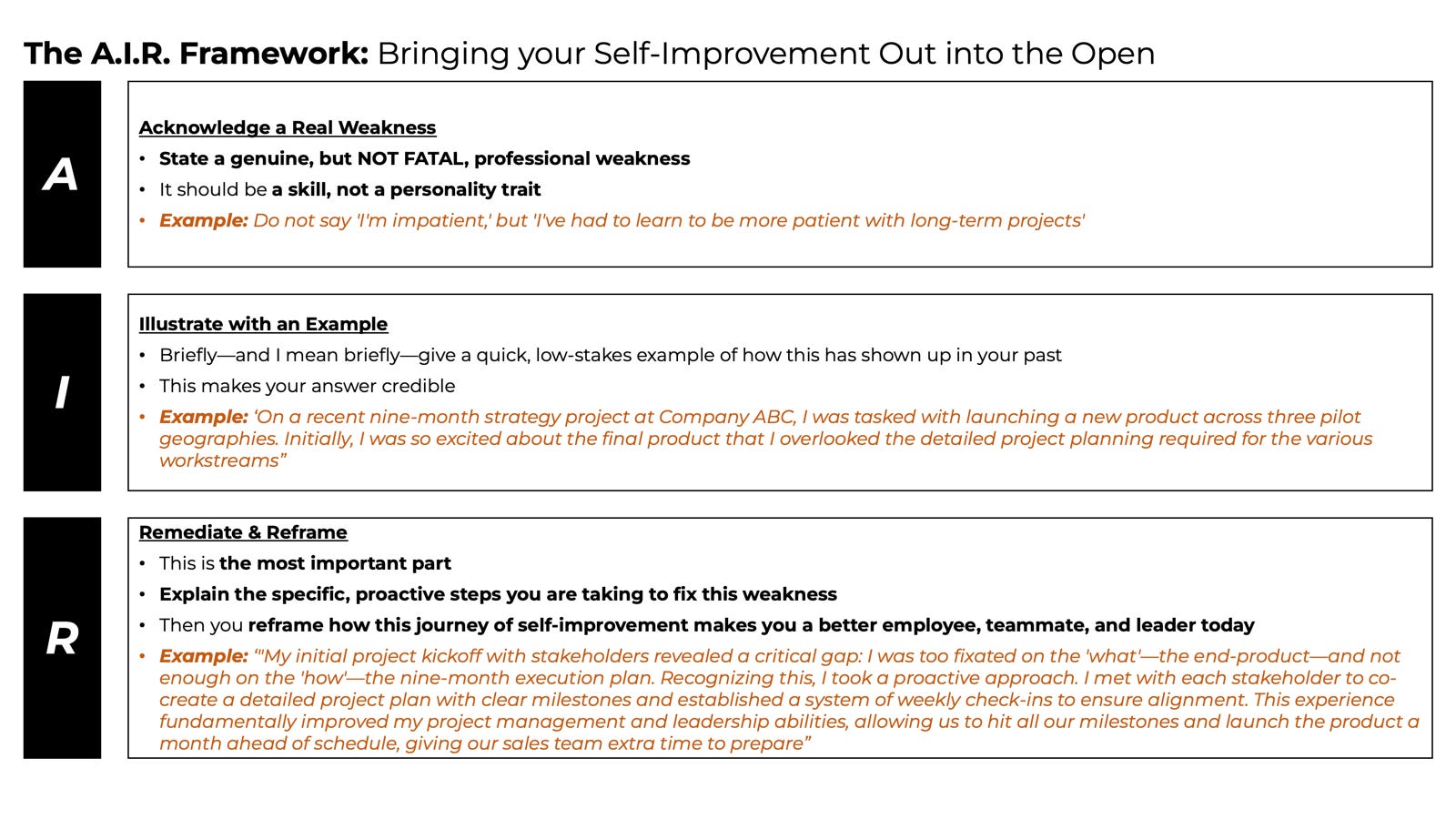
A stands for Acknowledge a Real Weakness
State a genuine, but not fatal, professional weakness. It should be a skill, not a personality trait.
So, not “I’m impatient,” but “I’ve had to learn to be more patient with long-term projects.”
I stands for Illustrate with an Example
Briefly, and I mean briefly, give a quick, low-stakes example of how this has shown up in your past. This makes your answer credible.
R stands for Remediate and Reframe
This is the most important part. Explain the specific, proactive steps you are taking to fix this weakness.
Then you reframe how this journey of self-improvement makes you a better employee, teammate, and leader today.
Case Study: “What’s Your Biggest Weakness?”
Let me run a classic example through the A.I.R. Framework.
(A) Acknowledge: “You know, one area I’ve had to actively work on is delegating tasks to my teammates. My natural tendency, especially when I’m passionate about a project, is to think, ‘It’s just faster if I do it myself,’ since I have all these ideas firing off in my brain already.”
(I) Illustrate: “I can think of an early project at my consulting firm where we had to market size the Canadian software sector. Right after the client call, my mind was racing with how to build the model. So I just started building it myself, even though I had a junior analyst who was supposed to own that workstream. It caused me to work unnecessary late nights and I wasn’t able to focus on the bigger strategic picture for the client.”
(R) Remediate & Reframe: “That was a real wake-up call. Since then, I’ve been very intentional about delegating by focusing on the big picture. I have more one-on-one conversations to understand my team’s strengths and what they want to get out of a project. It’s made me a much better leader. It not only frees up my time for higher-level thinking, but it also helps my team members grow and develop their own skills.”
See the power in that? It’s honest, it shows self-awareness, and it ends on a story of growth.
Other Tricky Questions
This same philosophy applies to other tricky questions.
“Why Should We Hire You?”
Here’s how you can frame it:
“Look, I’m sure the other candidates have years of direct industry experience. But what I bring is a diverse background that has forced me to get smart on new, highly ambiguous problems, fast. People who have been in one industry for a long time sometimes have a hard time asking, ‘But why are we doing it this way?’ That question is my starting point. The difference is, my varied experience has trained me to ask the right questions and synthesize complex information, which means I can hit the ground running and start making an impact from day one.”
“Where Do You See Yourself in 5 Years?”
Show ambition that aligns with their company. For example:
“In five years, I hope to not only be highly knowledgeable about the business and its strategies, but also to be a subject matter expert in this area. I want to be a true thought-partner to you and the executive team. I also hope to be on a path for a leadership position where I can make a direct impact on the business.”
You Don’t Need to Memorize the Letters
And with that, we’ve covered the core techniques for mastering the interview. You have frameworks for your past with STAR, your future with ACE, and the tricky ones in between with A.I.R.
And yes, I know that’s a lot of acronyms and frameworks.
But I want to be very clear: YOU DO NOT NEED TO MEMORIZE THESE! If you really think about it, they all follow the same simple, logical path. They start with the Context of a situation. They move to the Action you took. And they end with the Result or the solution.
The more you practice answering questions using the stories from your Skills Vault, the more this structure will become second nature. You’ll stop thinking about the letters and you’ll just start telling great stories.
And always remember, you can take a pause before answering any question. Telling an interviewer, “That’s a great question, let me take 30 seconds to jot down my thoughts,” is a power move. It is perfectly okay to do so.
Remember, we’re trying to take control of our narrative.
Your Task
So here’s your task. I want you to identify one real, but manageable, professional weakness. Something you are genuinely working on.
Ideas could be: becoming a better presenter, delegating more effectively, or getting better at prioritizing projects.
Then, write out a full answer using the A.I.R. framework. Practice it until it sounds confident, not confessional.
In the next posts, we’ll get even more specific and focus on the topics and questions that career changers dread the most, like “Why this industry and this company?” and how to handle salary expectations.
Great work. I’ll see you there.
Next up: Tackling the toughest topics for career changers
Here is the complete career playbook (all 26 posts with real-world interview, resume, and career examples) for anyone who is pivoting roles, industries, about to graduate, stuck in their current path, not sure what to do next, etc.