

How to Answer 'Why Are You Leaving?' Without Sounding Bitter
The 3 P's Formula: Being pulled toward opportunity, not pushed away from problems

Welcome back. In the last post, we crafted a powerful story to answer “Why this industry?” and “Why this company?”
Now we’re going to tackle its tricky sibling, the question that often comes right after, or sometimes even before: “That’s great, but why are you looking to leave your current company?”
This Question Is a Minefield
Let me start with a warning. This question is a minefield.
It is not an invitation to vent. I repeat: this is not the time to complain about your boss, your long hours, or how boring your work is.
That is the fastest way to get a red flag next to your name. They’ll just think, “If they’re complaining about their last company, they’ll complain about us too.”
On the other hand, if you say, “Oh, I love my job, everything’s perfect,” the interviewer is confused: “Then why are you here wasting my time?”
The Golden Rule
The secret to acing this question is to follow one golden rule: Frame your answer as being PULLED towards a new opportunity, not PUSHED away from an old problem.
This is a story about your ambition and growth, not your dissatisfaction.
To do this, we’ll use a simple, positive, and powerful formula called the “3 P’s Formula.”
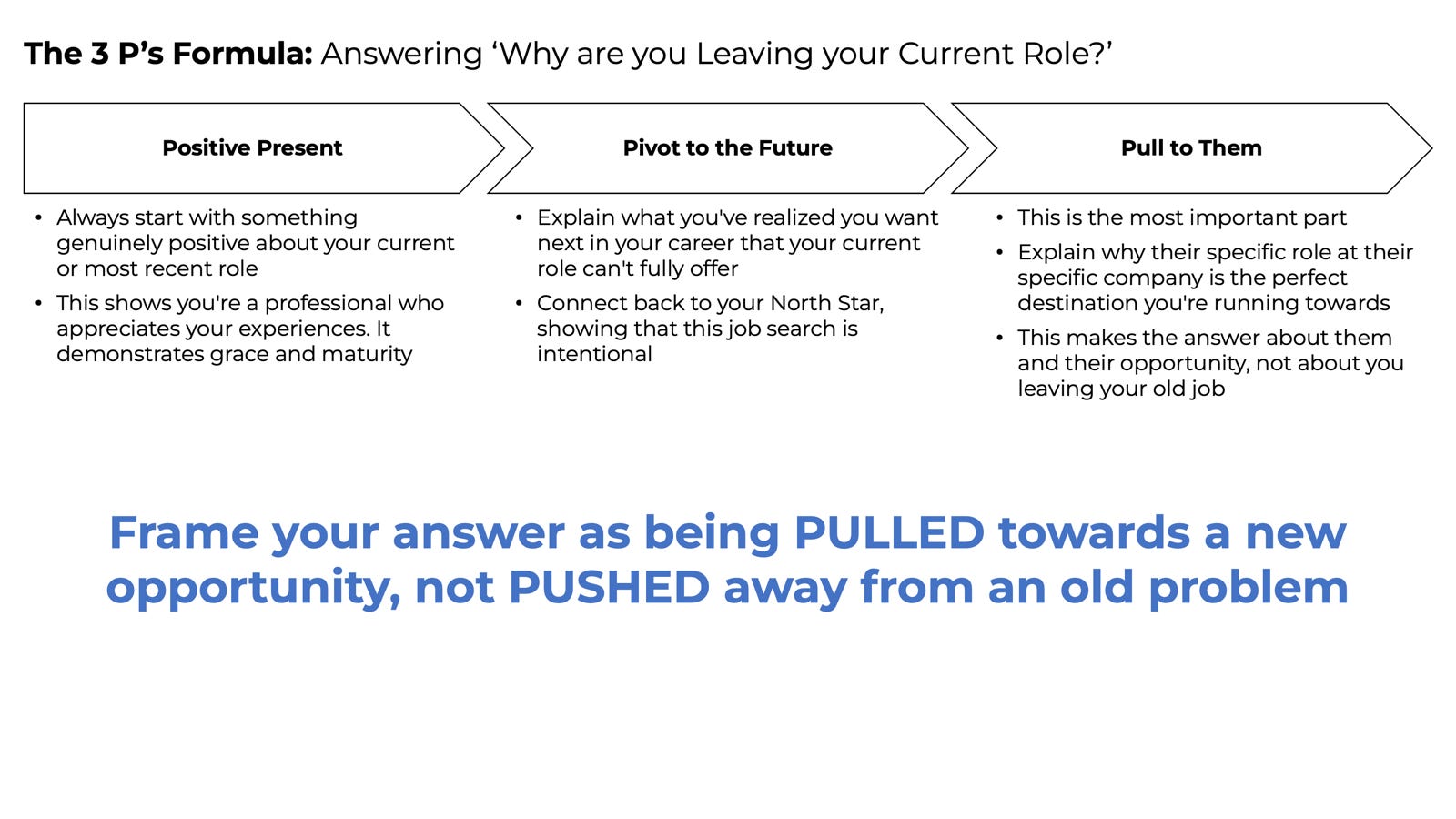
The 3 P’s Formula
First: Positive Present
You always start with something genuinely positive about your current or most recent role. This shows you’re a professional who appreciates your experiences. It demonstrates grace and maturity.
Second: Pivot to the Future
This is your transition. You explain what you’ve realized you want next in your career that your current role can’t fully offer.
This is where you connect back to your North Star, showing that this job search is intentional.
Third: Pull to Them
This is the most important part. You end by explaining why their specific role at their specific company is the perfect destination you’re running towards.
This makes the answer about them and their opportunity, not about you leaving your old job.
Case Study 1: My Pivot From Consulting to a Startup
Question: “You’re at a top consulting firm. Why would you want to leave for a small startup?”
(1. Positive Present): “I’ve had an incredible experience at my Consulting firm. The training is second to none, in strategy, leadership, people management, and analytics, and I’ve had the chance to solve complex problems and work directly with C-Suite executives. I’m especially grateful for the rigorous strategic framework I’ve developed there.”
(2. Pivot to the Future): “However, through that work, I’ve realized that I’m most energized not just by advising companies, but by actually building them. My goal now is to apply my consulting skill set in an environment where I can be closer to the ground level and own the execution of a strategy from start to finish.”
(3. Pull to Them): “So when I learned about this opportunity to help build your strategy from the ground up, it felt like the exact challenge I’ve been looking for. The chance to be part of a small, agile team of ex-consultants and directly shape the company’s growth is the perfect next step for me.”
See? It’s a completely positive story about moving towards a new kind of impact.
Case Study 2: Leaving My Healthcare Startup to Go Into Retail
Question: “So, why are you looking to leave your current strategy role?”
(1. Positive Present): “I’m really proud of the work our team is doing. I’ve had the opportunity to lead major strategic initiatives, including our partnership with a large retail company, and I’ve learned an immense amount about building a business from an early stage.”
(2. Pivot to the Future): “At the same time, this experience has really clarified what I want long-term. My true passion, which I first discovered when I launched my footwear brand years ago, is in the retail and apparel industry. I’ve realized that I want to dedicate my strategic skills to the unique challenges and opportunities within that space.”
(3. Pull to Them): “So when I saw this strategy role, it was an immediate click. The opportunity to work on the future of retail for such an iconic brand is precisely where I want to focus my career. It’s the perfect intersection of my strategy background and my personal passion.”
Your Task
Here’s your task for this post. I want you to craft your own answer using the 3 P’s Formula.
First, write one sentence about something genuinely Positive in your Present role.
Second, write your Pivot sentence: what have you realized you want next?
And third, write your Pull sentence: why is their role the perfect fit for that future?
And don’t worry, the “Pull” part can be a bit generic for now, since you may not have a specific job in mind at this very moment. That’s okay. You can even just find a role you like on LinkedIn and pretend that’s the one you’re interviewing for to make the exercise real.
Master this, and you’ll turn a tricky question into a powerful statement about your ambition and your future.
In the next post, we’re going to talk about the elephant in the room: money. We’ll break down how to handle questions about your salary expectations.
I’ll see you there.
Next up: How to handle salary expectations without losing leverage
Here is the complete career playbook (all 26 posts with real-world interview, resume, and career examples) for anyone who is pivoting roles, industries, about to graduate, stuck in their current path, not sure what to do next, etc.