

How to Handle Salary Expectations Without Losing Leverage
Research, strategy, and the scripts that actually work

Welcome back. We’ve talked about how to answer “Why this industry?” and “Why are you leaving your current role?”
Now it’s time to tackle the elephant in the room, the question that makes almost everyone uncomfortable: the one about money.
It Doesn’t Have to Be a Poker Game
The salary conversation can feel like a high-stakes poker game where you’re afraid to show your cards.
But it doesn’t have to be.
Today, I’m going to give you a playbook to handle this conversation with confidence and strategy. This isn’t a personal plea. It’s a business transaction, and you need to be prepared.
Step 1: Research the Range
The process starts with research. You need to find the salary range.
First, look for it on the job description. In many places now, like here in New York, employers are legally required to post a salary range. If it’s there, that’s your starting point.
Second, if you can’t find it, use online resources. A quick Google search for the role, company, and your location will often give you a decent estimate from sites that track this data.
Step 2: Do the Internal Work
Now, once you have an idea of the market rate, you need to do the internal work. You have to figure out what range is acceptable for you and your standard of living.
This is especially important for career changers, because sometimes, you will have to take a pay cut.
And I want to be very clear: that is okay.
There are many valid reasons for it. Maybe the new industry just doesn’t pay as much. Maybe you don’t have the direct experience to be a top-of-the-band candidate. Or maybe you’re coming from a field like investment banking or consulting that pays a huge amount.
I’ve taken pay cuts in my journey. It’s a strategic move.
Once you are in a role you are happy and passionate about, the money will come. Trust me. Look at successful people. They climb the ladder or find new opportunities because they love what they do and get really good at it.
The money follows the passion.
Step 3: Execute the Conversation
Okay, so you’ve done your research. You know what you need. Now you’re in the conversation with the recruiter.
Here’s how you execute.
The Golden Rule
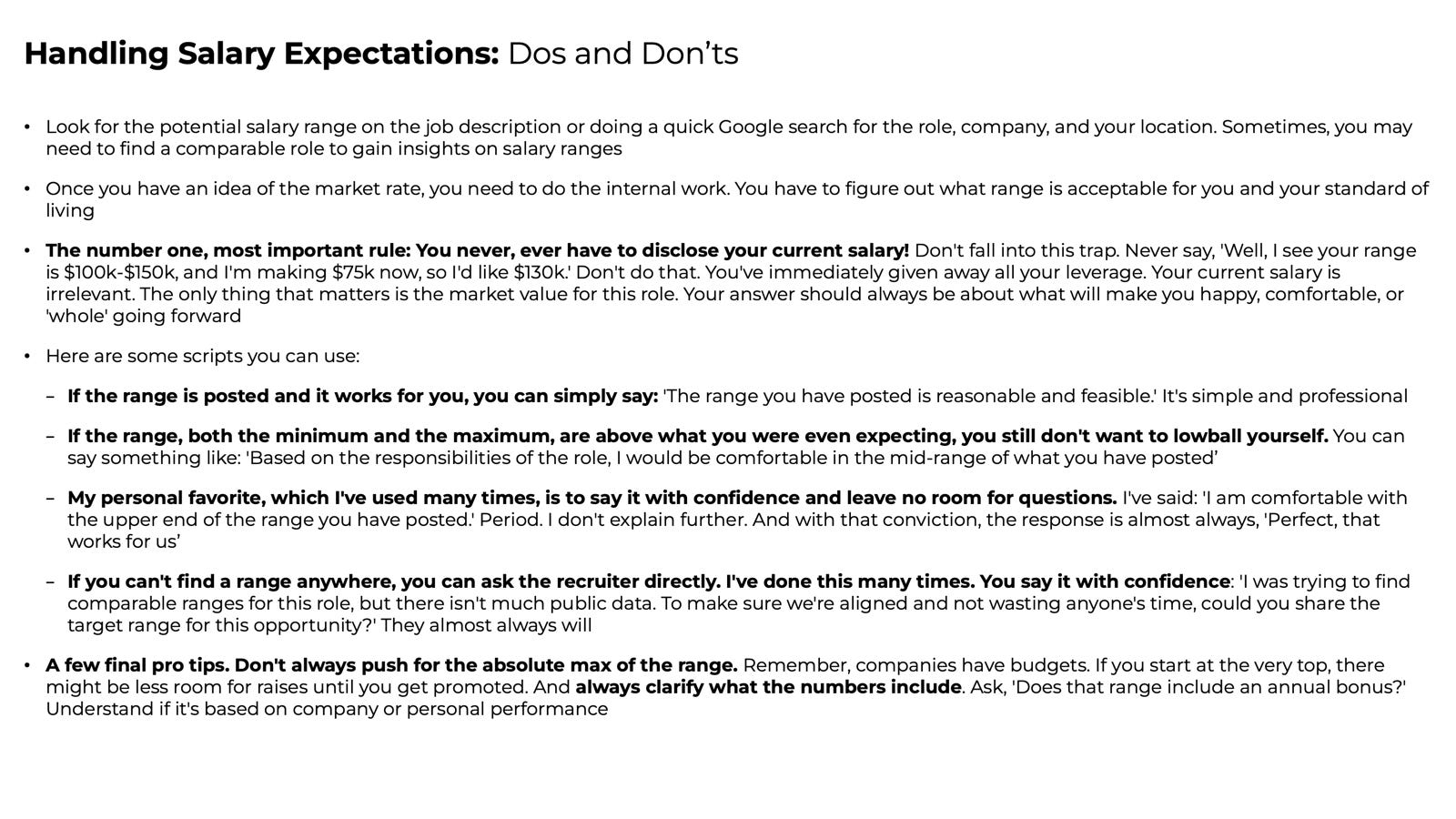
The number one, most important rule: You never, ever have to disclose your current salary.
Don’t fall into this trap. Never say, “Well, I see your range is $100K to $150K, and I’m making $75K now, so I’d like $130K.”
Don’t do that. You’ve immediately given away all your leverage.
Your current salary is irrelevant. The only thing that matters is the market value for this role.
Your answer should always be about what will make you happy, comfortable, or “whole” going forward.
The Scripts That Work
Here are some scripts you can use.
Script 1: When the Range Works for You
If the range is posted and it works for you, you can simply say:
“The range you have posted is reasonable and feasible.”
It’s simple and professional.
Script 2: When the Range Is Above Your Expectations
If the range, both the minimum and the maximum, are above what you were even expecting, you still don’t want to lowball yourself. You can say something like:
“Based on the responsibilities of the role, I would be comfortable in the mid-range of what you have posted.”
Script 3: The Confident Ask (My Favorite)
My personal favorite, which I’ve used many times, is to say it with confidence and leave no room for questions. I’ve said:
“I am comfortable with the upper end of the range you have posted.”
Period. I don’t explain further. And with that conviction, the response is almost always, “Perfect, that works for us.”
Script 4: When There’s No Posted Range
Now, what if you can’t find a range anywhere? You can ask the recruiter directly. I’ve done this many times. You say it with confidence:
“I was trying to find comparable ranges for this role, but there isn’t much public data. To make sure we’re aligned and not wasting anyone’s time, could you share the target range for this opportunity?”
They almost always will.
Pro Tips
A few final pro tips.
Don’t always push for the absolute max of the range. Remember, companies have budgets. If you start at the very top, there might be less room for raises until you get promoted.
And always clarify what the numbers include. Ask, “Does that range include an annual bonus?” Understand if it’s based on company or personal performance.
We’ll get into deep negotiation tactics in another post, but for now, just get the basic facts.
Your Task
Here’s your task.
First, research a realistic salary range for one of your North Star roles.
Second, pick one of the scripts we discussed and practice saying it out loud until it sounds natural and confident.
Conviction is key.
You’ve Completed This Phase
And with that, you have officially completed this phase. This was a big one.
We’ve tackled the questions that cause the most anxiety for career changers: “Why this industry?”, “Why are you leaving?”, and the big one about salary expectations.
You now have the strategies to handle these crucial conversations with confidence.
Now that you’ve mastered the core conversational parts of the interview, we’re moving into the final, advanced stages of the process.
In the next posts, we’ll dive into advanced interview strategies, starting with something that’s becoming incredibly common: the interview presentation and the case study.
Great work getting through this phase.
I’ll see you there.
Next up: Advanced interview strategies - presentations and case studies
Here is the complete career playbook (all 26 posts with real-world interview, resume, and career examples) for anyone who is pivoting roles, industries, about to graduate, stuck in their current path, not sure what to do next, etc.