

How to Answer 'What Would You Do If...' Questions With Confidence
The A.C.E. Framework for situational and hypothetical questions

Welcome back. In the last post, we broke down the STAR method to prove your past performance with powerful, structured stories. That handles about 80% of the interview.
But what about the other 20%?
What happens when they ask a question you can’t just pull a story for from your Skills Vault?
These are the situational and hypothetical questions. They start with phrases like, “What would you do if...?” or “Imagine a scenario where...?”
The Questions That Feel Like Traps
For example: “What would you do in your first 90 days?” or “Imagine your boss gives you a critical project with an impossible deadline. What do you do?”
These questions can feel like traps because there’s no single “right” answer. They can make you feel like you’re guessing.
But here’s the secret: They are not testing your ability to predict the future. They are testing your thought process.
The interviewer doesn’t want a perfect answer. They want to see structure, logic, and good judgment under pressure.
The A.C.E. Framework
To show them that, we’re going to use a simple, three-step framework. If STAR is for the past, this one is for the future.
It’s called the A.C.E. Framework.
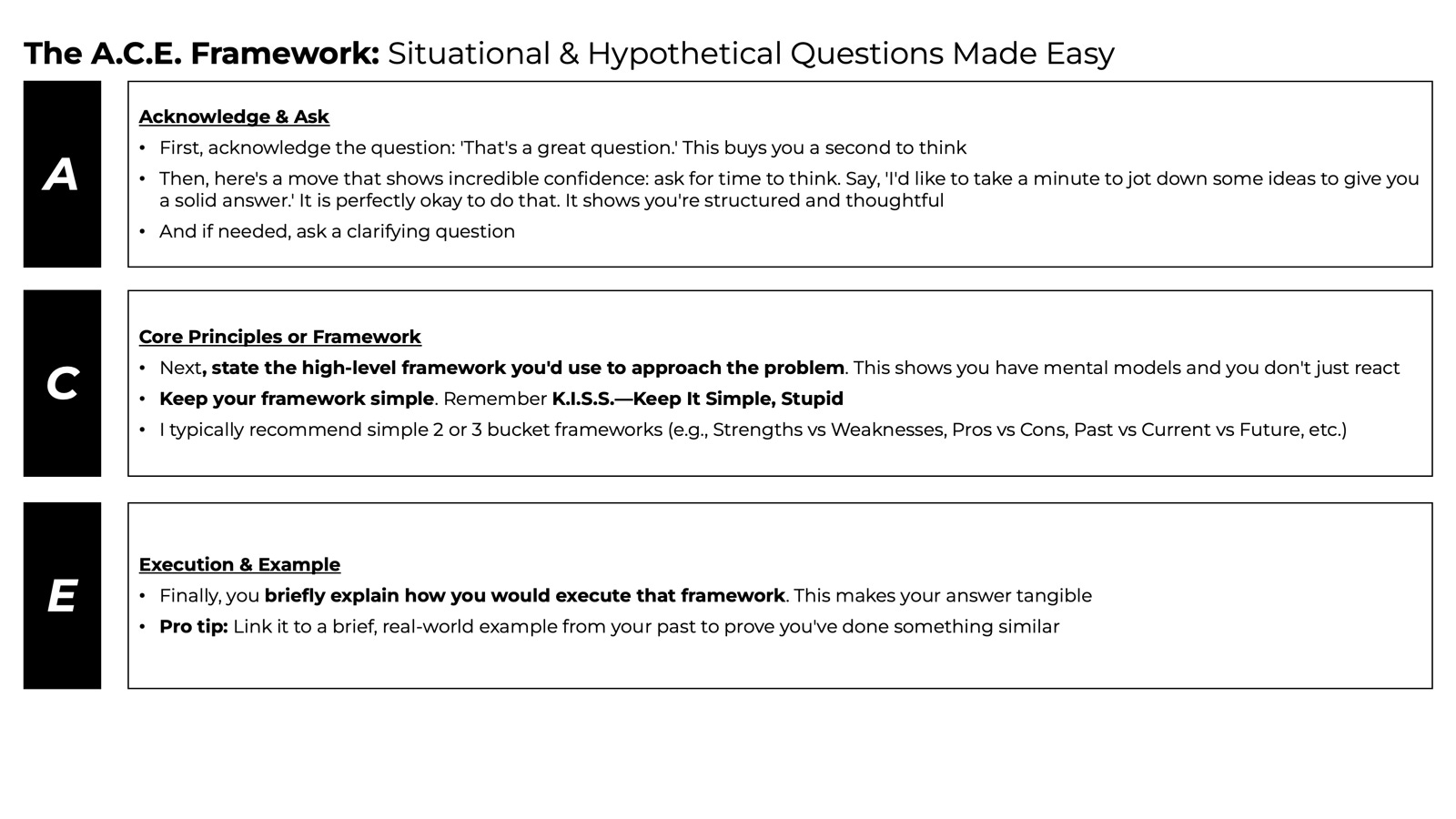
A stands for Acknowledge and Ask
First, acknowledge the question: “That’s a great question.”
This buys you a second to think. Then, here’s a move that shows incredible confidence: ask for time to think.
Say, “I’d like to take a minute to jot down some ideas to give you a solid answer.”
It is perfectly okay to do that. It shows you’re structured and thoughtful. And if needed, ask a clarifying question.
C stands for Core Principles or Framework
Next, state the high-level framework you’d use to approach the problem. This shows you have mental models and you don’t just react.
And keep your framework simple. Remember K.I.S.S. Keep It Simple, Stupid. I like to create simple 2 or 3-bucket frameworks.
E stands for Execution and Example
Finally, you briefly explain how you would execute that framework. This makes your answer tangible.
The pro move here is to link it to a brief, real-world example from your past to prove you’ve done something similar.
Case Study 1: The “First 90 Days” Question
Question: “What would you do in your first 90 days in this role?”
(A) Acknowledge: “That’s a great question. Let me take a minute to jot down my thoughts.” (Take a moment). “Okay. My focus for the first 90 days wouldn’t be on making big, immediate changes, but on deeply integrating with the team and the business.”
(C) Core Principles: “I’d break it down into three phases. The first 30 days is all about ‘Getting Smart,’ which means listening and learning about the company, the processes, and the key stakeholders. The next 30 days are about diagnosing and aligning, identifying opportunities for early wins. And the final 30 days would be about starting to execute on those first initiatives.”
(E) Execution/Example: “For instance, in that first month, my primary goal would be to schedule one-on-ones with every key person on my team and every cross-functional partner. I used a similar approach when I joined the healthcare startup, and those initial conversations were the foundation for my entire strategy.”
See that? It’s a structured, thoughtful answer that shows you have a plan. It’s low-ego and high-impact.
Case Study 2: The “Impossible Deadline” Question
Question: “Imagine your boss gives you a critical project with a deadline you believe is impossible. What do you do?”
(A) Acknowledge & Ask: “That’s a tough but realistic scenario. Again, I’d like to take a minute to jot down my ideas.” (Take a moment). “My first instinct isn’t to say no or to panic. It’s to get more clarity. I would ask my boss, ‘Could you help me understand the key drivers for this deadline? Is the date the most critical factor, or is the scope?’ This shows you’re a thought-partner in solving the problem.”
(C) Core Principles: “My framework would be to first assess the scope versus the resources, and then present data-driven options rather than a problem.”
(E) Execution/Example: “Then, I would go back to my boss with solutions, saying, ‘I’ve mapped it out. To hit this deadline, we can deliver these three critical features. If we need all five, we can hit it if we get additional help from Team X. Which path would you prefer?’ This reframes you from being a complainer to being a strategic problem-solver.”
It Won’t Be Perfect (And That’s Okay)
Now, I need to say something important.
This all sounds perfect written out, but in real life, it’s not going to come out exactly this polished. And that is okay.
We’re not trying to memorize these answers. But the more you practice using some kind of framework, it doesn’t have to be this one, the better you will get at structuring your thoughts on the fly.
You will shock yourself with how good you actually sound. So don’t get bogged down in trying to be perfect.
For these questions, showing your work is the answer. The “how” is more important than the “what.”
Your Task
Here’s your task for this post. Find two common hypothetical questions online.
The “first 90 days” is a good one, and another is, “How would you handle a disagreement with a coworker?”
For each one, write out an answer using the A.C.E. framework or any other simple framework that works for you.
Now that we’ve covered how to answer questions about the past and the future, we’re ready for the final category. In the next post, we’ll tackle some of the trickiest questions of all. The ones that feel like traps, like “What’s your biggest weakness?”
Great work. I’ll see you there.
Next up: Handling tricky questions like “What’s your biggest weakness?”
Here is the complete career playbook (all 26 posts with real-world interview, resume, and career examples) for anyone who is pivoting roles, industries, about to graduate, stuck in their current path, not sure what to do next, etc.