

Turn Your 'Weaknesses' Into Strengths With the P.O.W.E.R. Framework
How to address career gaps, pivots, and the "tricky" parts of your resume with confidence

Welcome back. I know this is a post that many of you have been waiting for with a mix of excitement and maybe a little dread.
We’ve built our core story. Now we have to talk about the parts of our story that we fear the most.
The Moments Your Stomach Tightens
These are the moments in an interview where your stomach tightens.
The interviewer looks at your resume and asks: “So, I see you left Investment Banking...why did you do that?” or “What were you doing during this one-year gap here?” or “Your pivot from finance to healthcare seems a little random. Can you walk me through that?”
For most people, these questions trigger the Outsider Complex. They get defensive, they get apologetic, and they stumble.
Today, we are going to flip that script entirely.
You are going to learn how to turn these perceived weaknesses into your greatest strengths. These questions are not traps. They are invitations to show your character, intention, and resilience.
The P.O.W.E.R. Framework
To do this, there is a simple, five-part framework that I want you to burn into your brain.
It’s called the P.O.W.E.R. Framework, because it’s about taking back the power in your narrative.
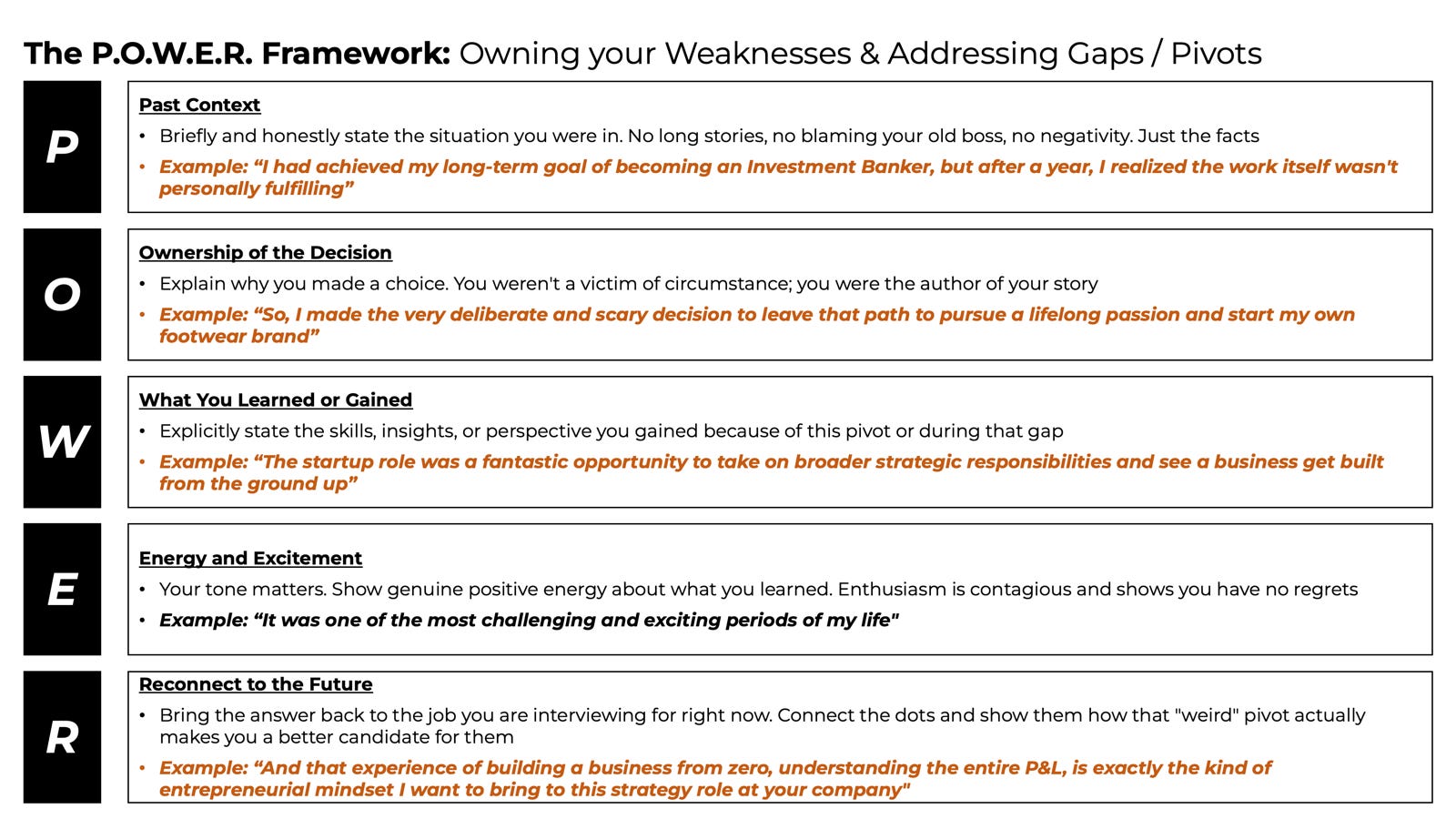
P stands for Past Context
Briefly and honestly state the situation you were in. No long stories, no blaming your old boss, no negativity. Just the facts.
O stands for Ownership of the Decision
This is crucial. You have to show that you were in the driver’s seat. Explain why you made a choice.
You weren’t a victim of circumstance. You were the author of your story.
W stands for What You Learned or Gained
This is where you reframe everything. Explicitly state the skills, insights, or perspective you gained because of this pivot or during that gap.
This is where the “off-track” time becomes valuable.
E stands for Energy and Excitement
Your tone matters. Show genuine positive energy about what you learned. Enthusiasm is contagious and shows you have no regrets.
R stands for Reconnect to the Future
This is the knockout punch. You must bring the answer back to the job you are interviewing for right now.
Connect the dots and show them how that “weird” pivot actually makes you a better candidate for them.
Case Study 1: Leaving Investment Banking for My Footwear Brand
Let me run two of my own pivots through the P.O.W.E.R. Framework.
(P) Past Context: I had achieved my long-term goal of becoming an Investment Banker, but after a year, I realized the work itself wasn’t personally fulfilling.
(O) Ownership: So, I made the very deliberate and scary decision to leave that path to pursue a lifelong passion and start my own footwear brand.
(W) What I Learned: In those two years, I learned more than in any corporate job. I learned about product development, supply chain, marketing from scratch, and true accountability.
(E) Energy: It was one of the most challenging and exciting periods of my life.
(R) Reconnect: And that experience of building a business from zero, understanding the entire P&L, is exactly the kind of entrepreneurial mindset I want to bring to this strategy role at your company.
See that? No apology. It’s a story of intention and growth.
Let me try a trickier one: leaving L.E.K. Consulting for a startup, driven by personal reasons.
Case Study 2: The Work-Life Balance Pivot
(P) Past Context: I was in a demanding strategy consulting role, and my wife and I were starting our family planning journey.
(O) Ownership: I made a conscious choice to find a role with better work-life balance so I could be a more supportive partner during that important time.
(W) What I Learned: The startup role was a fantastic opportunity to take on broader strategic responsibilities and see a business get built from the ground up with the backing of a large corporation.
(E) Energy: I’m incredibly grateful for that experience and the balance it gave me.
(R) Reconnect: And now, with my family in a wonderful place, I’m energized and ready to bring that combination of startup hustle and big-firm consulting rigor back to a challenging environment like this one.
The Number One Rule
The number one rule through all of this: Never apologize for your journey.
It’s your Mosaic. Own it. Every piece of it has value.
Your Task
So here’s your task.
I want you to identify the one or two “trickiest” parts of your resume. Is it a gap between jobs? A pivot that seems random?
For each one, I want you to write out a full answer using the five steps of the P.O.W.E.R. Framework.
Then, practice saying it out loud until it feels confident and natural.
You’ve Completed Crafting Your Narrative
And with that, you have officially completed this phase.
You have your resume. You have your “Tell Me About Yourself” pitch. And now you have the P.O.W.E.R. to explain any part of your unique journey.
Now that our core narrative tools are built, we’re ready to deploy them against any question they can throw at us.
In the next posts, we’ll dive deep into mastering behavioral interview questions using frameworks like S.T.A.R., and tackling the toughest topics for career changers.
Fantastic work.
I’ll see you there.
Next up: Mastering behavioral interview questions
Here is the complete career playbook (all 26 posts with real-world interview, resume, and career examples) for anyone who is pivoting roles, industries, about to graduate, stuck in their current path, not sure what to do next, etc.